 96 382 55 77


White spots on gums are small lesions or whitish patches that appear on the gum tissue. They can come from harmless, short-lived causes such as a canker sore or a build-up of bacterial plaque, or from changes in the lining of the mouth that need to be examined, such as leukoplakia.
Chances are you noticed the white spots in the mirror and now wonder whether they are serious, whether they are contagious or whether they will go away on their own. That worry is understandable, because two white spots that look almost identical can have very different causes, and a harmless appearance does not always mean a harmless lesion. In this guide we explain how to tell them apart, what causes them, what you can do at home and when a specialist should see them.
At Clínica Dental Asensio, Dr. Lucía Asensio Romero (Collegiate No. 46002287) assesses lesions of the oral lining in the oral medicine consultation of our oral medicine clinic in Valencia. Clinical guides, such as the Mayo Clinic page on leukoplakia, recommend seeing a professional when a white patch or sore does not heal on its own within two weeks. If the white spot hurts, has pus or comes with a fever, our emergency dentist in Valencia will see you without waiting for a scheduled appointment.
What are white spots on the gums and why do they appear?
White spots on the gums are areas where the oral lining changes colour for a specific reason: a thickening of the surface, an ulcer covered with fibrin, a colony of fungus, a collection of pus or a layer of bacterial plaque. Healthy gum is pink and smooth. When something irritates, infects or injures it, the tissue reacts and turns whitish. That is why the same outward appearance can hide very different causes.
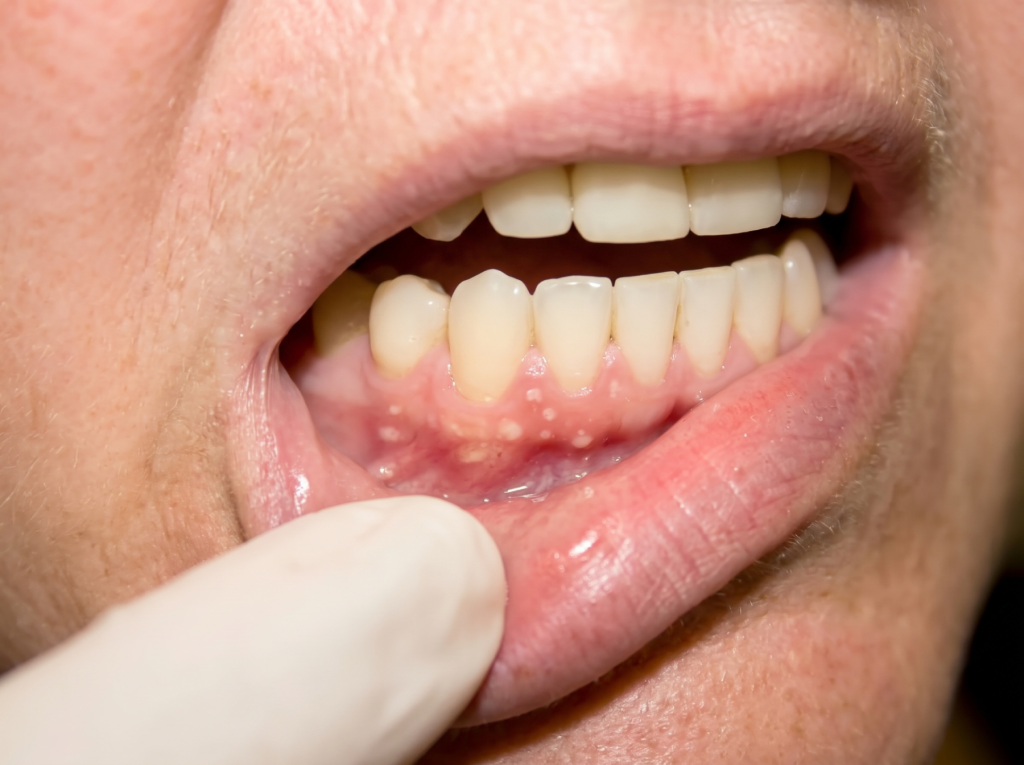
The most important point is that white is not a diagnosis. It is a signal. A canker sore, oral thrush, an abscess, a burn or leukoplakia can all look like a white spot or patch, and only an examination shows which one it is. That is why white spots should not be treated blindly with home remedies, nor ignored for weeks.
The causes fall into two broad groups. The most common are harmless and usually clear up within days or weeks: canker sores, irritation from rubbing or burns, bacterial plaque and oral thrush in people who are prone to it. The less common ones need professional follow-up because the lesion persists or may change over time: leukoplakia, oral lichen planus or an abscess with a fistula of dental origin. The table summarises the main causes and links each one to the matching guide on our website.
| Cause | What happens in the gum | How common | More information |
|---|---|---|---|
| Canker sore or ulcer | Shallow ulcer covered with a whitish or yellowish layer | Very common | How to heal mouth sores |
| Oral thrush (candidiasis) | Creamy patches caused by a fungus, which come off and leave the lining red | Common in people who are prone to it | Oral candidiasis |
| Abscess or fistula | Whitish or yellowish bump with pus, of dental origin | Common | Infected tooth extraction |
| Plaque and inflammation | Whitish film along the gum edge, with redness and bleeding | Very common | How to reduce gum inflammation |
| Rubbing or burn | Whitish area caused by a recent mechanical or chemical injury | Common | Clears up once the cause is removed |
| Leukoplakia or lichen planus | Patch or network of white lines that does not come off when rubbed | Uncommon | Oral medicine |
As a practical rule, white spots that appear suddenly and hurt usually have a short-lived cause, while those that appear slowly and do not hurt deserve more attention. We explain this in the following sections.
How to tell white spots apart by their appearance
Four features help to narrow down the cause of a white spot on the gum: whether it hurts, whether it comes off, what the edge looks like and how long it has been there. None of them replaces a dentist’s examination, but they let you describe what you see accurately and decide how urgently to book a visit.
Pain is the first clue. An ulcer or an abscess usually hurts, especially when eating, brushing or touching the area. Leukoplakia or lichen planus, by contrast, are usually painless, which is why they can go unnoticed for months. The absence of pain is not reassuring: it is a reason to watch more closely.
The second clue is whether the patch comes off. Oral thrush forms creamy patches that can be wiped away and leave red lining underneath. Leukoplakia forms patches that cannot be wiped away, as the Mayo Clinic describes. You should not test this by scraping with a fingernail or an object, because you can injure the tissue and blur the picture. The dentist assesses it safely during the examination.
The third feature is the edge and outline. Canker sores have a well-defined red border and a whitish or yellowish base. Abscesses form a rounded bump, sometimes with an opening that releases pus. Lichen planus lesions draw fine white lines in a lace-like pattern. Leukoplakia patches have irregular outlines.
| What you see | What it usually suggests | What to do |
|---|---|---|
| Painful ulcer with a red halo, less than two weeks old | Canker sore | Look after the area and watch that it heals on its own |
| Creamy patches that come off and leave red gum | Possible oral thrush | See the dentist to confirm it |
| Whitish or yellowish bump next to a tooth, with pus | Abscess or fistula of dental origin | Book an urgent appointment |
| Whitish film along the gum edge, with bleeding | Plaque and inflammation | Improve hygiene and book a cleaning |
| Painless white patch or lines that do not come off | Possible leukoplakia or lichen planus | Book an oral medicine check-up |
| Any lesion that has not healed in two weeks | Cause still to be determined | Book a check-up without waiting longer |
The fourth feature is time. A lesion that appears and disappears within a week or two is rarely a concern. One that stays or grows deserves a check-up.
White spots on the gums that hurt: canker sores, abscesses and plaque
White spots that hurt are usually due to one of three causes: a canker sore, a dental abscess or inflammation from bacterial plaque. All three cause pain, but they differ in appearance and in how they evolve, and they call for very different responses.
A canker sore is a small, round ulcer with a whitish or yellowish centre and a red border. It hurts with acidic or salty foods and usually heals on its own in one or two weeks. It is the most common cause of a painful white spot and does not point to a serious disease. If they keep coming back or stop you from eating, they deserve a consultation. Our guide on how to heal mouth sores explains the treatments and the foods that help.
An abscess is the cause you should take most seriously. A whitish or yellowish bump on the gum next to a tooth that releases pus or leaves an unpleasant taste points to an infection that usually starts in the tooth or its root. It does not go away on its own: the pus drains, but the infection remains. Treatment depends on the origin and may be a root canal treatment or, if the tooth cannot be saved, an extraction, which we explain in our article on infected tooth extraction. If there is also a fever or facial swelling, do not wait: our guide on when to go to an emergency dentist helps you recognise a real emergency.
Bacterial plaque produces a whitish film along the gum edge. When it builds up, the gum turns red, swells and bleeds when you brush. This inflammation responds well to a professional cleaning and good hygiene, as we explain in how to reduce gum inflammation. If left untreated, it can progress to a gum disease that is handled in the periodontics consultation.
| Cause | What it looks like | How it evolves | When to see the dentist |
|---|---|---|---|
| Canker sore | Round ulcer, whitish centre, red border | Heals on its own in 1-2 weeks | If it lasts over two weeks or keeps recurring |
| Abscess or fistula | Whitish or yellowish bump with pus next to a tooth | Does not resolve on its own | As soon as you notice it |
| Plaque and inflammation | Whitish film with red gums that bleed | Improves with cleaning and hygiene | If the bleeding persists |
Painless white spots on the gums: when to keep watch
Painless white spots deserve more attention than painful ones, because the lack of discomfort lets a lesion go unchecked for months. The two causes that raise the most concern are leukoplakia and oral lichen planus, and both are diagnosed in the consultation.
Leukoplakia forms thick, white or grey patches on the gums, cheeks or floor of the mouth, and they do not come off when rubbed. It is painless. According to the Mayo Clinic, most patches are not cancerous, but some show early signs of cancer, which is why a professional should assess them. Those that combine white areas with raised red areas are more likely to change. Tobacco, whether smoked or chewed, is the factor most linked to its appearance. Heavy, sustained alcohol use, broken or sharp teeth and ill-fitting dentures also favour it.
Oral lichen planus is a chronic inflammatory condition that draws fine white lines, sometimes with red areas or erosions. It may be felt as sensitivity to spicy or acidic food, although it often causes no symptoms. It is managed with regular check-ups and, when needed, treatment. Both lesions are handled in our oral medicine consultation.
Another common painless cause is repeated rubbing: a denture that rubs, a tooth with a sharp edge or the habit of biting the cheek hardens the lining and turns it whitish. In those cases, removing the cause is usually enough, and the dentist can polish the tooth or adjust the denture.
| Sign | Why it matters | What to do |
|---|---|---|
| It has not healed in over two weeks | A short-lived lesion usually resolves sooner | Book a check-up |
| The patch does not come off and is painless | This is the typical look of leukoplakia | Book an oral medicine check-up |
| Red areas are mixed with the white ones | It may indicate a lesion that needs study | Book a check-up soon |
| There is a hard lump, bleeding or numbness | These are not signs of a simple lesion | Seek consultation without waiting |
| You smoke or drink alcohol often | These are the most associated risk factors | Have regular check-ups and quit tobacco |
A timely check-up costs little and brings peace of mind. If a lesion is harmless, you will know sooner, and if it needs follow-up, that follow-up will start early.
What to do at home and what to avoid if you have white spots on your gums
The most useful thing at home is to keep the area clean, avoid irritating it and watch how it evolves. These measures do not replace a consultation, but they prevent the lesion from getting worse while you wait for your appointment, and they let a harmless cause resolve without complications.
Brush gently with a soft-bristled toothbrush and clean between your teeth carefully, without pressing hard on the sore area. Regular hygiene reduces bacterial plaque, which is one of the most common causes. Our guide on tooth brushing covers the right technique. Avoid very acidic, spicy, salty or hard foods while the area is sensitive, because they irritate the lining and prolong the discomfort.
Four habits are best avoided. Do not scrape or try to pull off the white spot, because you can injure the tissue and open the door to infection. Do not pop a bump with pus, because it does not remove the cause. Do not apply harsh substances, such as alcohol, hydrogen peroxide, aspirin placed directly on the gum or cleaning products, because they can burn the lining and produce new white marks. And do not smoke, because tobacco irritates the lining and slows healing.
If the white spot appeared after a treatment or from a denture rubbing, note the date and avoid using the part that rubs until the dentist has checked it. It helps to write down when it appeared, whether it has changed size and whether it hurts, because these details make the diagnosis easier.
| Do | Avoid | Reason |
|---|---|---|
| Brush gently and clean between teeth | Rubbing the area hard | Reduces plaque without injuring the gum |
| Eat soft, lukewarm foods | Acidic, spicy or hard foods | Avoids irritating the lining |
| Watch and note how it evolves | Scraping or pulling off the white spot | Scraping can injure the tissue |
| Quit smoking | Smoking or chewing tobacco | Tobacco slows healing |
| Book a check-up if it does not improve in two weeks | Applying alcohol, hydrogen peroxide or aspirin | They can burn the lining |
How the dentist diagnoses and treats white spots on the gums
The dentist diagnoses white spots with an examination of the mouth and a conversation about when they appeared and what goes with them. In many cases this is enough to identify the cause. When the lesion cannot be explained at a glance or persists, other tests complete the picture.
The consultation starts with a clinical history: how long the lesion has been there, whether it hurts, whether it has changed, what medication you take, whether you smoke and whether you have any condition that affects your defences. The specialist then examines the gum, the nearby teeth and the rest of the lining, and checks whether the patch comes off. If a dental origin is suspected, an X-ray is requested to assess the tooth root.
If the lesion remains unclear, or if it looks that way, the specialist may order a biopsy, which means taking a small tissue sample for analysis. It is a simple procedure, done under local anaesthetic, and it is the only way to confirm the diagnosis of certain lesions. When a wider intervention is needed, the case is referred to the oral and maxillofacial surgery unit.
Treatment depends on the cause and has no single formula. A canker sore is treated with local measures, oral thrush with an antifungal prescribed by the specialist, an abscess by treating the affected tooth, plaque with a professional cleaning, and leukoplakia or lichen planus with regular follow-up and, if appropriate, specific treatment. Drugs and doses are always decided by the professional after seeing your case. All of these conditions fall under oral medicine, the specialty that studies diseases of the lining of the mouth.
| Cause | How it is confirmed | Usual approach |
|---|---|---|
| Canker sore | Clinical examination | Local measures and control of the cause |
| Oral thrush | Examination, sometimes a culture | Antifungal prescribed by the specialist |
| Abscess or fistula | Examination and X-ray | Treatment of the affected tooth |
| Plaque and inflammation | Examination of the gums | Professional cleaning and better hygiene |
| Leukoplakia or lichen planus | Examination and, if appropriate, biopsy | Regular follow-up and specific treatment |
Frequently asked questions about white spots on the gums
Are white spots on the gums serious?
Most are not. The most common causes, such as canker sores, rubbing or plaque, are harmless and clear up in days or weeks. What matters is not to ignore a lesion that lasts more than two weeks, that is painless and does not come off, or that comes with a lump, bleeding or numbness. In those cases, a check-up rules out or confirms a cause that needs follow-up.
Can they be a sign of oral cancer?
In most cases they cannot, but some white patches, such as certain leukoplakias, can show early signs of cancer or progress towards it, as the Mayo Clinic notes. That is why it is recommended to consult when a white patch does not heal on its own in two weeks. An early diagnosis allows you to act in time.
Are white spots on the gums contagious?
Canker sores, leukoplakia and lichen planus are not contagious. Oral thrush mainly appears when the balance of the mouth is altered, for example by wearing dentures, taking certain medication or having weakened defences, and it is rarely a contagion problem between healthy adults. If in doubt, the dentist assesses your case.
How long do they take to go away?
It depends on the cause. A canker sore usually heals on its own in one or two weeks. Irritation from rubbing disappears when the cause is removed. An abscess, by contrast, does not go away without treatment, and leukoplakia or lichen planus are lesions that persist and are managed with check-ups. If the white spot is still there after two weeks, book a check-up.
Why do I have white spots on my gums and they bleed?
A whitish film combined with bleeding when you brush usually points to inflammation from a build-up of bacterial plaque. It improves with a professional cleaning and consistent hygiene. If the bleeding persists, or appears with bad breath or receding gums, the periodontics service should assess it.
What should I do if the white spot has pus?
A bump with pus next to a tooth points to a possible infection of dental origin. Do not pop it or wait for it to disappear: book an appointment as soon as possible. If there is a fever, facial swelling or difficulty swallowing or breathing, go to the emergency service.
What if the white spots are on the tongue or the palate?
Some causes are shared, such as oral thrush or canker sores, but others are specific to each area. If you see them on the tongue, our guides on the cracked tongue and on oral candidiasis can help you. In any case, if they last more than two weeks, they should be checked.
What should I do if my child has white spots on the gums?
In babies and young children, small white cysts often appear on the gum and are usually harmless. Even so, it is best to have a professional confirm it, in the paediatric dentistry consultation, especially if the child has discomfort, a fever or refuses food.


