 96 382 55 77


Porcelain crowns in Valencia are full-coverage dental restorations made entirely of ceramic that cover a damaged tooth to restore its shape, size, function, and aesthetics without any visible metal components.
When a tooth has suffered such extensive destruction that it can no longer be restored with a filling or a veneer, a porcelain crown is the solution that provides the patient with a functional tooth that is aesthetically integrated with the rest of the smile. The problem many patients face is that old metal-ceramic crowns often show a dark line at the gum level over the years, ruining a result that was once satisfactory. Metal-free porcelain crowns eliminate this problem at its source.
Dr. Lucía Asensio Romero (Registration No. 46002287) and the team at Asensio Dental Clinic work with internationally recognized ceramics to guarantee the natural appearance and durability of every crown. If you want to discover all available aesthetic options, visit our cosmetic dentistry in Valencia page.
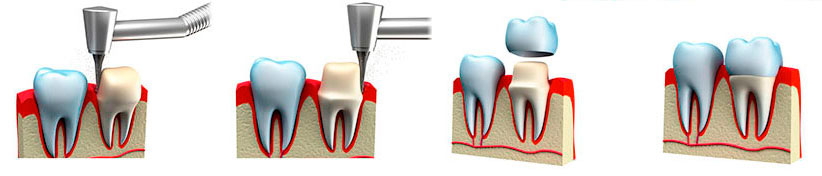
What are porcelain crowns and when are they indicated?
A dental crown is a restoration that covers the entire clinical crown of the tooth — the visible part above the gum line — protecting it and restoring its original morphology. Porcelain crowns are made entirely of ceramic, without any metal core or structure, which gives them a translucency and natural appearance that metal-ceramic crowns cannot match.
The primary indications for a porcelain crown include extensive structural destruction of the tooth due to deep decay or fracture, severe weakening after a root canal (endodontics), generalized wear from bruxism that has reduced the clinical crown to its minimum, and the aesthetic replacement of old metal-ceramic crowns that show a dark “halo” at the gingival margin. They are also used as a restorative element over dental implants when the anterior sector requires the highest level of aesthetic integration.
It is important to distinguish porcelain crowns from dental veneers: while a veneer covers only the front face of the tooth with minimal preparation, a crown covers the entire piece and requires a perimeter reduction of the tooth between 1 and 2 mm. A crown is always the choice when the tooth no longer has enough structure to support a veneer or when the destruction affects multiple faces of the tooth.
| Indication | Porcelain Crown | Porcelain Veneer |
|---|---|---|
| Extensive structural destruction | Yes — primary option | No — insufficient structure |
| Endodontically treated tooth | Yes — protects the weakened tooth | Only in very selected cases |
| Aesthetic correction of front face | Possible but more invasive | Yes — more conservative option |
| Crown over implant | Yes — frequent indication | Not applicable |
| Replacement of metal-ceramic crown | Yes — eliminates the dark halo | Not applicable |
Types of porcelain crowns: Feldspathic ceramic, Lithium Disilicate, and Zirconia
Within metal-free crowns, there are different ceramic materials, each with distinct mechanical and aesthetic properties that determine its indication. At Asensio Dental Clinic, we select the material based on the tooth’s location, the biting forces it will be subjected to, and the aesthetic requirements of each case.
Feldspathic ceramic is the material with the highest translucency and naturalness, used mainly in the anterior sector where aesthetic demands are maximum and chewing forces are lower. Lithium disilicate — marketed under brands like IPS e.max — combines very high aesthetics with higher mechanical resistance than feldspathic ceramic, making it suitable for both the anterior sector and premolars. Zirconia is the strongest material, preferably indicated for molars and patients with bruxism where forces are higher.
| Material | Aesthetics | Strength | Primary Indication |
|---|---|---|---|
| Feldspathic ceramic | Very high | Medium | Anterior sector, low load |
| Lithium Disilicate (e.max) | High | High | Anterior and premolars |
| Zirconia | High | Very high | Molars, bruxism, implants |
What is the process for placing a porcelain crown in Valencia?
The process of placing a porcelain crown at Asensio Dental Clinic follows a three-visit protocol designed to guarantee precise fit, aesthetic integration, and patient comfort at each stage.
In the first visit (free), we perform a complete examination and study the case with clinical photography and an intraoral scanner. In the second visit, we prepare the tooth under local anesthesia — reducing its perimeter to create space for the crown — and take digital impressions. We place a temporary crown that protects the prepared tooth and allows the patient to validate the aesthetics before the final restoration. The laboratory fabricates the final ceramic crown using CAD/CAM technology within one to three weeks. In the third visit, we cement the permanent crown, verify the occlusion (bite), and make any necessary final adjustments.
At Asensio Dental Clinic, we never cement a final crown without the patient having validated the aesthetic result with the temporary one. This step eliminates the main source of dissatisfaction in crown treatments: the discrepancy between the expected and final result.
Price of porcelain crowns in Valencia
The price of porcelain crowns depends on the chosen material, the number of teeth, and the complexity of the case. At Asensio Dental Clinic, we provide a personalized, no-obligation quote after the first free visit. Check our cosmetic dentistry pricing page for more information on rates and interest-free financing options.
Frequently Asked Questions about porcelain crowns
Do porcelain crowns break?
Pure porcelain crowns are more sensitive to direct impacts than zirconia or metal-ceramic ones. For anterior sectors with low chewing forces, they are completely safe. For molars or patients with bruxism, we recommend zirconia, which offers greater strength without sacrificing aesthetics.
How long does a porcelain crown last?
With proper maintenance, a porcelain crown has an average durability of 10 to 15 years. Longevity depends on the patient’s oral hygiene, the absence of uncontrolled parafunctional habits, and regular clinical check-ups. At Asensio Dental Clinic, we include annual check-ups in all crown treatments.
Is it obvious that it is an artificial crown?
With current ceramic and manufacturing technology, porcelain crowns are practically indistinguishable from natural teeth. The lab customizes the color, morphology, and translucency level of each crown so that it integrates perfectly with the patient’s adjacent teeth.
Does a porcelain crown require special care?
The care for a porcelain crown is the same as for a natural tooth: proper brushing twice a day, use of dental floss or interproximal brushes, and regular clinical check-ups. It does not require any additional product or routine. The only point of attention is the margin between the crown and the gum, where plaque can accumulate if hygiene is not rigorous.
Can I get a porcelain crown if I have an implant?
Yes. Porcelain crowns are one of the most frequent options for restoration over an implant, especially in the anterior sector. For more information on implants and their restoration options, visit our dental implants in Valencia page.