 96 382 55 77


Pediatric orthodontics in Valencia refers to the set of orthodontic treatments specifically designed to correct dental alignment and maxillary development issues in children and adolescents. Acting during the growth period allows us to take advantage of bone plasticity to resolve problems that, in adulthood, would require much more complex treatments or even surgery.
Many parents wait until all permanent teeth have erupted before taking their children to the orthodontist, missing the most effective window of opportunity to intervene. The Spanish Society of Orthodontics recommends the first orthodontic check-up at ages 6-7, when baby and permanent teeth still coexist, and bone growth is at its most favorable stage for correction.
At Asensio Dental Clinic, we have been providing pediatric orthodontic treatments in Valencia for over 20 years. All cases are planned and supervised by Dr. José Luis Lanuza (Registration No. 46002399), an orthodontics specialist with extensive experience in interceptive and corrective treatments for growing patients. On this page, you will find everything you need to know about when to start, what types of treatment exist, and how the process works.
When should a child visit the orthodontist?
The first orthodontic check-up is recommended between ages 6 and 7, coinciding with the eruption of the first permanent molars and central incisors. At this age, the orthodontist can evaluate bone and dental development, detect incipient problems, and determine if early intervention is necessary or if it is better to wait for full permanent dentition.
There are signs that may indicate the need for a check-up before that age: prolonged finger or pacifier sucking habits beyond 3-4 years, regular mouth breathing, difficulties chewing or speaking, or a bite that visually appears incorrect. Faced with any of these signs, it is advisable to consult with the orthodontist without waiting for the standard review age.
Early detection does not always imply immediate treatment. In many cases, the orthodontist establishes a periodic monitoring plan and determines the optimal time to intervene according to each child’s growth evolution.
Phases of Pediatric Orthodontics
Pediatric orthodontics is usually organized into two phases depending on the patient’s age and dental development stage.
| Interceptive Orthodontics (Phase 1) | Applied between ages 6 and 10, during mixed dentition. Its goal is to guide jaw growth and correct bite problems before they worsen. It uses removable or fixed appliances that act on the growing bone. It is not always necessary — the orthodontist determines if the case benefits from early intervention or if it is better to wait. |
| Corrective Orthodontics (Phase 2) | Applied from ages 11-12 onwards, once all permanent teeth have erupted. Its goal is to correct the final position of the teeth and the relationship between the arches. It uses fixed brackets — metal, esthetic, or self-ligating — or, in some cases, clear aligners like Invisalign Teen. |
Removable Appliances in Pediatric Orthodontics
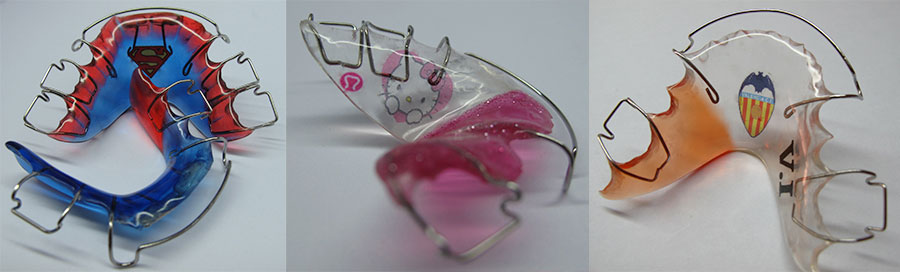
Removable appliances are the primary instrument of interceptive orthodontics. They can be removed by the child themselves for oral hygiene and during meals, which facilitates maintaining good oral health during treatment.
One of the advantages most valued by children — and their parents — is that at Asensio Dental Clinic, removable appliances can be personalized with countless designs and colors. This makes the appliance the child’s own, reducing treatment rejection and improving compliance with usage time.
Dentofacial Orthopedics in Children
Sometimes the problem of a bad bite is not in the teeth but in the bones that support them. Dentofacial orthopedics is the area of dentistry that corrects malocclusions caused by alterations in the growth of the dental arches and jawbones. It can only be applied while bone growth exists, making it an exclusive treatment for children and adolescents. If not detected in time, treatment in adults is much more complex and may require orthognathic surgery.
The most common orthopedic appliances we use at Asensio Dental Clinic are the following:
Face mask: exerts force on the upper jaw to encourage its forward development. It is commonly used in combination with a rapid palatal expansion appliance. It is for home use and well-tolerated by patients.
Rapid Palatal Expander (RPE): grows the palate bone very effectively. It is highly efficient and comfortable for the patient. It can be fixed or removable depending on the case.
Extraoral traction: slows down the forward development of the upper jaw. Highly indicated in cases with prominent upper teeth. It is normally used in a home setting.
Chin cups: placed in well-selected cases to modulate jaw growth. Less commonly used today due to its limited effectiveness compared to other options.
Benefits of Pediatric Orthodontics
| Takes advantage of bone growth | Intervening during the growth period allows for the correction of bone problems that in adulthood can only be resolved with orthognathic surgery. |
| Shorter and simpler treatments | Problems detected and treated in time require less treatment time and less complex appliances than if addressed in adulthood. |
| Improves oral health | A correct bite facilitates chewing, reduces premature tooth wear, and improves hygiene by eliminating areas difficult for the brush to reach. |
| Improves pronunciation | Some bite problems directly affect the pronunciation of certain sounds. Correcting them during language development facilitates correct diction. |
| Psychological benefits | An aligned smile during childhood and adolescence contributes positively to self-esteem and social confidence during a particularly sensitive developmental stage. |
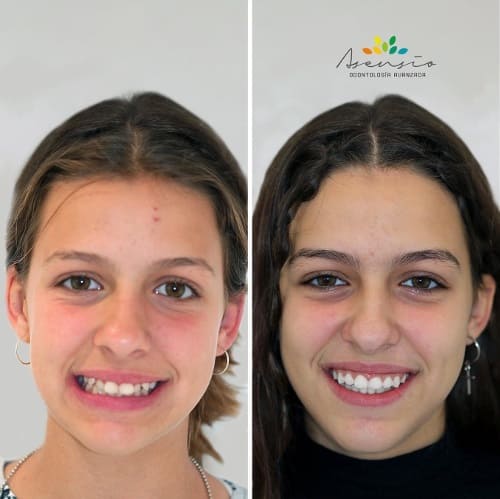
Pediatric Orthodontics Results: Before and After
Price of Pediatric Orthodontics in Valencia
The price of pediatric orthodontics in Valencia varies depending on the type of treatment — interceptive or corrective — the complexity of the case, and the expected duration. Phase 1 interceptive treatments are usually shorter and more affordable than full Phase 2 corrective treatments.
At Asensio Dental Clinic, we offer interest-free financing to split the payment into monthly installments tailored to each family. Check the detailed prices for pediatric orthodontics and all orthodontic treatments or request your personalized, no-obligation quote during the first free consultation.
Frequently Asked Questions about Pediatric Orthodontics
At what age can a child get braces?
It depends on the type of treatment. Interceptive orthodontics can start from ages 6-7 if the orthodontist detects problems that benefit from early intervention. Full corrective treatment with braces usually begins at ages 11-12, once all permanent teeth have erupted. There is no maximum age limit — orthodontics is equally effective in adults, although the process may be slightly slower.
Do pediatric braces hurt?
It is normal for the child to feel pressure and sensitivity in the teeth during the first few days after the appliance is placed and after each adjustment visit. This discomfort usually disappears in two or three days and subsides with over-the-counter pain relievers if necessary. Phase 1 removable appliances cause less discomfort than fixed braces as they can be removed at specific times.
How often should we visit the orthodontist?
Once treatment has started, visits are usually every four to six weeks for fixed braces treatments, and slightly less frequent for removable appliances. Appointments are usually short — between 15 and 20 minutes — for control adjustments. Dr. Lanuza establishes the frequency of check-ups according to the needs of each case.
How long does pediatric orthodontic treatment last?
Phase 1 interceptive treatments usually last between six and eighteen months depending on the problem to be corrected. Phase 2 corrective treatments have a similar duration to those of adults — between twelve and twenty-four months depending on the complexity of the case. If the child has had a previous interceptive treatment, the corrective phase is usually shorter and simpler.
Are the results of pediatric orthodontics permanent?
Yes, if the retention instructions are correctly followed after finishing the treatment. When appliances are removed, a retainer is placed to maintain the position achieved. Without retention, teeth have a natural tendency to partially return to their original position. In general, there is a tendency for lower incisors to crowd with age, regardless of whether there has been orthodontic treatment.
Can removable appliances damage the teeth?
No. Orthodontic appliances do not damage teeth, but bacterial plaque does. If hygiene is poor during treatment, there is a risk of cavities or gum inflammation. Therefore, it is essential to brush teeth after every meal and also clean the removable appliance before putting it back on.
Can you eat with removable appliances on?
No. Removable appliances must be removed for eating. This is precisely one of their advantages over fixed braces — there are no dietary restrictions or difficulties for hygiene. After eating, you must brush your teeth and clean the appliance before putting it back in.
Is interceptive orthodontics necessary if the child will need braces anyway?
In many cases, yes. Interceptive orthodontics does not eliminate the need for a later corrective phase, but it simplifies it significantly. Correcting a bone problem during growth avoids the need for more aggressive dental movements or, in extreme cases, orthognathic surgery during the corrective phase. The investment in the interceptive phase usually reduces the cost and duration of the corrective phase.
Can children use Invisalign?
Yes. Invisalign has a specific version for teenagers — Invisalign Teen — which includes a compliance indicator and replacement aligners in case of loss. The only requirement is that the patient has all permanent teeth erupted, which usually occurs around ages 11-12. For younger children in the interceptive phase, conventional removable appliances are generally more suitable.
What happens if orthodontics is not treated in childhood?
Orthodontic problems not treated in childhood do not disappear on their own — in most cases, they worsen over time. An untreated crossbite can cause asymmetrical enamel wear and TMJ problems. Severe crowding can hinder hygiene and increase the risk of cavities and periodontal disease. And some bone problems that are easily correctable during growth require orthognathic surgery if addressed in adulthood.