 96 382 55 77


Gaps between teeth are visible spaces between two neighbouring teeth. When the space appears between the crowns, it is called a diastema, and when it appears next to the gum because the papilla has receded, it is called an open embrasure or “black triangle”.
If you have noticed a space between your teeth, it is normal to wonder whether it is a harmless cosmetic detail or a sign that something is wrong. Food getting trapped, gaps that look bigger than before or feeling shy about smiling are also common. Two gaps that look alike can have very different origins, and the origin determines the treatment. In this guide we explain what diastemas and black triangles are, what causes them, when to keep an eye on them and how they are closed.
At Clínica Dental Asensio, Dr. José Luis Lanuza Guillem, an orthodontics specialist (Licence No. 46002399), and Dr. Lucía Asensio Romero (Licence No. 46002287) assess each gap according to its cause before proposing a solution. Clinical sources such as the Cleveland Clinic note that a diastema does not usually affect oral health, but that a new gap, or one that changes size, may point to gum disease and should be checked.
What are gaps between teeth? Diastemas and black triangles
A gap between teeth is a free space between two teeth that should be touching or very close together. Dentistry distinguishes two main types, because they originate in different places and are treated differently: the diastema and the black triangle.
A diastema is a space between the crowns of two neighbouring teeth. It can appear anywhere in the mouth, but it is most frequent and most visible between the two upper central incisors. Its cause usually lies in the relationship between tooth size, bone and soft tissue, and it normally produces no symptoms.
A black triangle, or open gingival embrasure, is the triangular gap left at gum level, just below the point where two teeth touch. In a healthy mouth the papilla, the small peak of gum between teeth, fills that space. When the papilla recedes, the triangle stays open and looks like a small dark gap. The periodontal literature calls it an open gingival embrasure, and its treatment may require orthodontic, periodontal and restorative care combined.
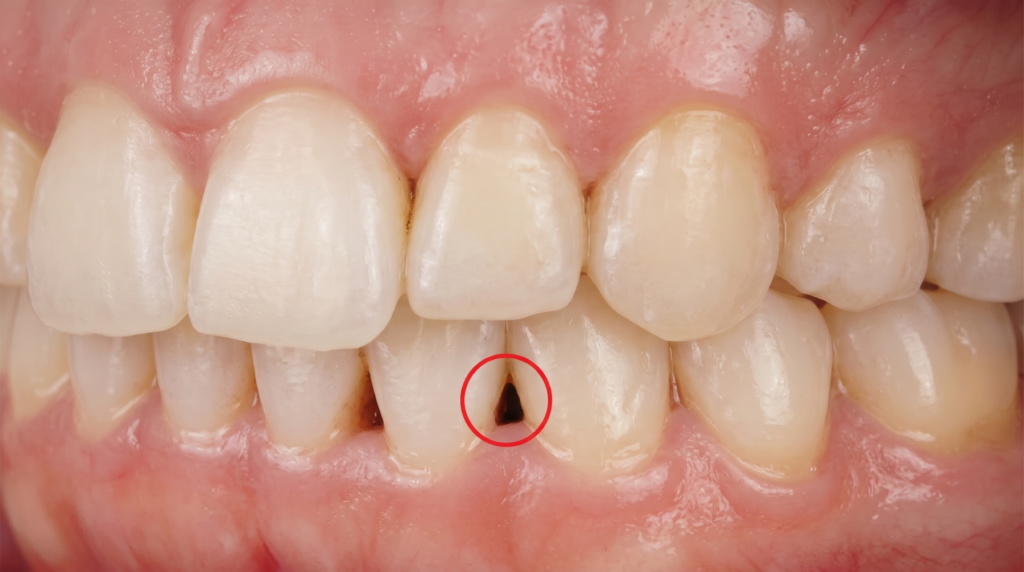
The practical difference matters. A diastema is corrected by moving the teeth or changing their shape. A black triangle is corrected by working on the gum, on the shape of the tooth or on both. That is why a prior examination avoids proposing a treatment that does not solve the problem.
| Aspect | Diastema | Black triangle |
|---|---|---|
| Where it is | Between the crowns of two teeth | Next to the gum, below the contact point |
| Most common area | Between the upper central incisors | Between incisors, both upper and lower |
| What causes it | Tooth and bone size, frenum, habits, missing teeth | Papilla loss, receded gums, tooth shape, previous orthodontics |
| Symptoms | Usually none | Trapped food and, sometimes, bleeding |
| Main approach | Orthodontics, veneers or composite | Periodontics, shape adjustment and restoration |
Why diastemas appear between teeth
Diastemas appear because of a mismatch between tooth size and available space, because of tissue that pushes the teeth apart or because of a habit that moves them. Heredity weighs heavily: the Cleveland Clinic points out that many people are genetically prone to them, and that inherited traits such as small teeth or missing teeth can leave gaps.
The first cause is dental. When teeth are small for the jaw, there is spare room and spaces form between them. When a tooth is missing, the neighbouring teeth tend to tilt towards the gap and spaces open up. Our article on what happens if you don’t replace a missing tooth with an implant explains how teeth drift after an extraction.
The second cause is the labial frenum. If the frenum, the fold of tissue between the upper lip and the gum, is thick or runs low between the incisors, it can keep the two central teeth apart. In that case a frenectomy, a small oral surgery procedure, is considered before closing the space with orthodontics.
The third cause is habits. Pushing the tongue forward when swallowing, thumb sucking in childhood, a tongue piercing or biting objects move the incisors gradually. Bruxism and bone loss from periodontitis can also separate teeth, and in those cases the gap grows over time.
One last fact reassures many families: in children, a space between the upper incisors is part of normal development and often closes when the permanent canines come through. Even so, if the gap persists in the permanent teeth, a specialist should assess it, and can guide follow-up in children’s orthodontics.
| Cause | How it creates the gap | Does it stay or grow? |
|---|---|---|
| Teeth small for the arch | There is spare room and teeth stay apart | Stays for life |
| Missing tooth | Neighbouring teeth tilt into the space | May grow |
| Thick labial frenum | The tissue stops the incisors from meeting | Stays without treatment |
| Tongue or habits | Repeated pressure on the incisors | Grows while the habit continues |
| Periodontitis | Bone loss and tooth mobility | Grows over time |
Why black triangles appear
Black triangles appear when the gum papilla stops filling the space between two teeth. That loss of gum has several causes, and telling them apart is what allows the right treatment to be chosen.
The most frequent cause in adults is periodontal disease. A review on interdental papilla management states that the most common reason in the adult population is loss of periodontal support from plaque-associated lesions. When the gum is chronically inflamed and the bone is reabsorbed, the papilla drops and the gap opens. Early inflammation is recognised by bleeding and redness, and is explained in our guide on how to reduce gum inflammation.
The second cause is aggressive brushing. Scrubbing hard or flossing roughly damages the gum and makes it recede. Gentle, consistent hygiene protects the papilla, and the right technique is detailed in our article on tooth brushing.
The third cause is tooth shape. Square or very triangular incisors, with the contact point far from the gum, leave a larger space below the contact. If the roots also diverge, as can happen after orthodontic treatment, the interdental space increases. Finally, ageing makes the gum recede gradually and leaves a little more space visible.
Black triangles are not only an aesthetic problem. The open triangle traps food, makes cleaning harder and, in some cases, affects the pronunciation of certain sounds. That is why treatment aims to restore at least part of the closure, not just to disguise the space.
| Cause of the black triangle | What happens | Who deals with it |
|---|---|---|
| Periodontal disease | Bone and gum lose support and the papilla drops | Periodontics |
| Aggressive brushing or flossing | The gum is injured and recedes | Guided hygiene and review |
| Square or triangular teeth | The contact point sits far from the gum | Restorative dentistry |
| Diverging roots after orthodontics | The space between the roots increases | Orthodontics and periodontics |
| Age | The gum recedes gradually | Regular follow-up |
When a gap between teeth is a problem
A stable gap that has not changed in years and causes no discomfort is usually just an aesthetic trait. A new gap, one that grows or one that comes with other symptoms deserves a check, because it may point to gum disease or to tooth movement that should be stopped.
The most important warning sign is change. If the spaces between your teeth appear suddenly or increase over months, the support of the tooth may be failing. Periodontitis destroys the bone that holds the teeth, and they drift and open up. You will recognise it because the gum bleeds, smells bad or recedes, and sometimes the tooth feels slightly loose. Our guide on why teeth move explains the causes and when to worry.
The second sign is food retention. If food gets stuck in the same gap every time you eat, the gum in that area becomes inflamed more easily and the risk of decay between the teeth rises. A gap that accumulates plaque calls for a functional solution, not only an aesthetic one.
The third sign is pain or discomfort when biting. A tooth that is moving apart and hurts may have an infection or be overloaded, and in that case you should not wait. If the pain is severe or there is swelling, our emergency dentist in Valencia service sees you without an appointment.
When the gap is old, stable and painless, the decision to close it is personal. Some people regard it as part of their smile and others want a more even one. In both cases a check-up confirms that the gum and bone are healthy before deciding.
| Sign | What it may indicate | What to do |
|---|---|---|
| Stable gap for years, no discomfort | Anatomical or aesthetic trait | Routine check-up and decide whether to close it |
| New or growing gap | Tooth movement or gum disease | Book a check-up soon |
| Bleeding, bad breath or receding gum | Gingivitis or periodontitis | Periodontal assessment |
| Constantly trapped food | A space that accumulates plaque | Interdental cleaning and a closure plan |
| Pain when biting or a loose tooth | Infection or overload | Seek care without waiting |
How gaps between teeth are closed
Gaps are closed by moving the teeth, changing their shape or working on the gum, and the choice depends on the cause, the size of the space and what each patient wants. There is no single treatment: the specialist combines options according to the case.
Orthodontics moves the teeth until the space closes and is the reference option when the gap is wide, when there are several spaces or when there are also bite problems. It can be done with fixed appliances or clear aligners. Our pages on orthodontics in Valencia and Invisalign explain how they work, and the comparison of invisible orthodontics: pros and cons helps you choose. Afterwards, a retainer holds the position, because without retention teeth tend to partly drift back.
Veneers close the space without moving the teeth, by slightly widening each one. Composite veneers are often the most suitable option for small diastemas because they are reversible and lower in cost, and porcelain veneers and Lumineers are more durable alternatives for mild cases. They are not suitable when there is moderate or severe misalignment, which requires orthodontics first.
A frenectomy removes or corrects the frenum that keeps the incisors apart, and is done before closing the space. For black triangles, periodontics treats the inflammation and can work on the gum, and restorative dentistry rebuilds the shape of the tooth to reduce the triangle. If a tooth is missing, the solution is to replace it, as our cosmetic dentistry in Valencia page explains. Smile design lets you see the result before starting.
| Treatment | When it is indicated | What it provides |
|---|---|---|
| Fixed orthodontics or Invisalign | Wide or multiple gaps, or bite problems | Closes the space by moving the teeth |
| Composite veneers | Small diastemas with well-aligned teeth | Quick, reversible and affordable closure |
| Porcelain veneers or Lumineers | Mild cases seeking more durability | Aesthetic closure without moving the teeth |
| Frenectomy | Thick frenum between the incisors | Allows the space to close |
| Periodontics and restoration | Black triangles from receded gum or tooth shape | Treats the gum and reduces the triangle |
| Replacing the missing tooth | Gap caused by a lost tooth | Restores support and prevents drifting |
How to care for gaps between teeth and stop them growing
Keeping the gums healthy and cleaning the spaces well is what stops a gap from growing and prevents decay or inflammation. An open gap exposes more surface, and therefore needs a little more attention than a closed contact between two teeth.
Daily interdental cleaning is the foundation. Floss, interdental brushes or a water flosser remove the plaque that the toothbrush does not reach, and the size of the interdental brush should match the gap so it does not injure the gum. In wide gaps, the interdental brush is usually more comfortable and effective than floss. Brushing should be gentle, with soft bristles, because scrubbing hard causes exactly the recession you want to avoid.
Regular check-ups allow changes in the gap to be spotted in time. The dentist measures the space, checks the gum and mobility, and may request an X-ray to assess the bone. A professional cleaning removes the tartar that home hygiene does not and that keeps the papilla inflamed.
If you wear a retainer after orthodontics, use it as instructed: it is what keeps closed the spaces that took effort to close. And if you have a habit that pushes the teeth, such as tongue thrust, bruxism or a tongue piercing, treat it, because the gap will come back if the habit continues. Quitting smoking also helps, because it worsens gum disease.
| Do | Avoid | Reason |
|---|---|---|
| Clean the gap daily with an interdental brush or floss | Leaving plaque built up between the teeth | Plaque inflames the gum and makes the triangle grow |
| Brush gently | Scrubbing hard or flossing roughly | The gum is injured and recedes |
| Have regular check-ups and cleanings | Waiting until the gap is more noticeable | Detect in time whether it is growing |
| Wear the retainer after orthodontics | Abandoning retention | Teeth tend to return to their place |
| Treat habits such as bruxism or tongue thrust | Keeping piercings or biting objects | They push the teeth and reopen the spaces |
Frequently asked questions about gaps between teeth
Do gaps between teeth close on their own?
In children, the space between the upper incisors usually closes when the permanent canines come through. In adults, a diastema caused by tooth size or by the frenum does not close on its own and stays for life. If the gap grows, it is not closing or opening by chance: there may be a periodontal cause that should be checked.
Is it normal to have a gap between the front teeth?
Yes, it is very common and in most cases does not affect health. The diastema between the central incisors has a strong hereditary component. What you should watch is that it does not change size or come with bleeding, mobility or pain, because then it may indicate gum disease.
Can a diastema be closed without orthodontics?
Yes, in mild cases with well-aligned teeth. Composite or porcelain veneers slightly widen each tooth and close the space in one or a few visits. They are not the best option when there is moderate or severe misalignment, because then it is better to move the teeth first with orthodontics.
Do gaps open again after being closed?
They can. After orthodontics, teeth tend to return to their original position if a retainer is not used, which is why retention is part of the treatment. If the gap was caused by a habit, such as tongue thrust, it also does not stay closed until that habit is corrected.
Why have gaps suddenly appeared?
New spaces are a reason to consult. They may be due to bone loss from periodontitis, a lost tooth, bruxism or a habit that pushes the teeth. Book a check-up soon to find the cause and stop the movement before it progresses.
Can black triangles be filled?
It depends on their size and cause. In some cases the shape of the tooth is rebuilt with composite to reduce the triangle, and in others the gum is worked on with periodontics. Some techniques, such as hyaluronic acid filling, aim to restore papilla volume, and the specialist assesses at the consultation whether they suit your case. You can see how this material is used in our article on hyaluronic acid in cosmetic dentistry.
How much does it cost to close a gap between teeth?
It depends on the technique: closing with composite, veneers and orthodontics have very different costs. You can check our orthodontic prices and cosmetic dentistry prices, and at the first visit you receive a quote tailored to your case.
Which specialist treats gaps between teeth?
It depends on the cause. The orthodontist moves the teeth, the cosmetic dentistry specialist reshapes them with veneers or composite, and the periodontist treats the gum and bone. At our clinic they work in a coordinated way, so a single assessment defines which combination your case needs.


