 96 382 55 77


Invisalign attachments are small tooth-coloured composite bumps bonded to the tooth surface to improve aligner grip. They act as mechanical anchor points, letting the aligner apply more precise force for movements that would otherwise be difficult to control.
It’s common for a patient starting treatment to worry about this step — will they show? Does the bonding process hurt? What happens if one comes off halfway through treatment? These are reasonable concerns: unlike the clear aligner itself, an attachment stays fixed to the tooth for weeks or months, and its correct placement plays a major role in whether the final result matches the plan.
At Asensio Dental Clinic, Dr. José Luis Lanuza (Colegiado Nº 46002399), an Invisalign Diamond Provider since 2002 with over 1,000 completed cases — verifiable on his official invisalign.es profile — plans and places every attachment within the Invisalign treatment in Valencia. The position and shape of each attachment isn’t a judgement call made in the chair — it’s defined by digital planning software before the first aligner is even manufactured.
What are Invisalign attachments and what are they for?
An Invisalign aligner is a plastic shell that wraps around the tooth crown, but on its own it has limited grip for certain movements. The attachment solves that: it’s a small light-cured composite bump, matched to the natural enamel colour, bonded at an exact point calculated by the ClinCheck software. The aligner is manufactured with a cavity shaped exactly like the attachment, so the two pieces fit together like a key in a lock.
That mechanical connection is what lets the aligner transmit force to the tooth in three dimensions, not just surface pressure. A well-placed attachment turns the aligner into a tool capable of rotating, extruding, intruding or tipping the root of a tooth — movements that plastic alone can’t execute with precision, because it would simply slide over the smooth crown without transmitting the necessary force.
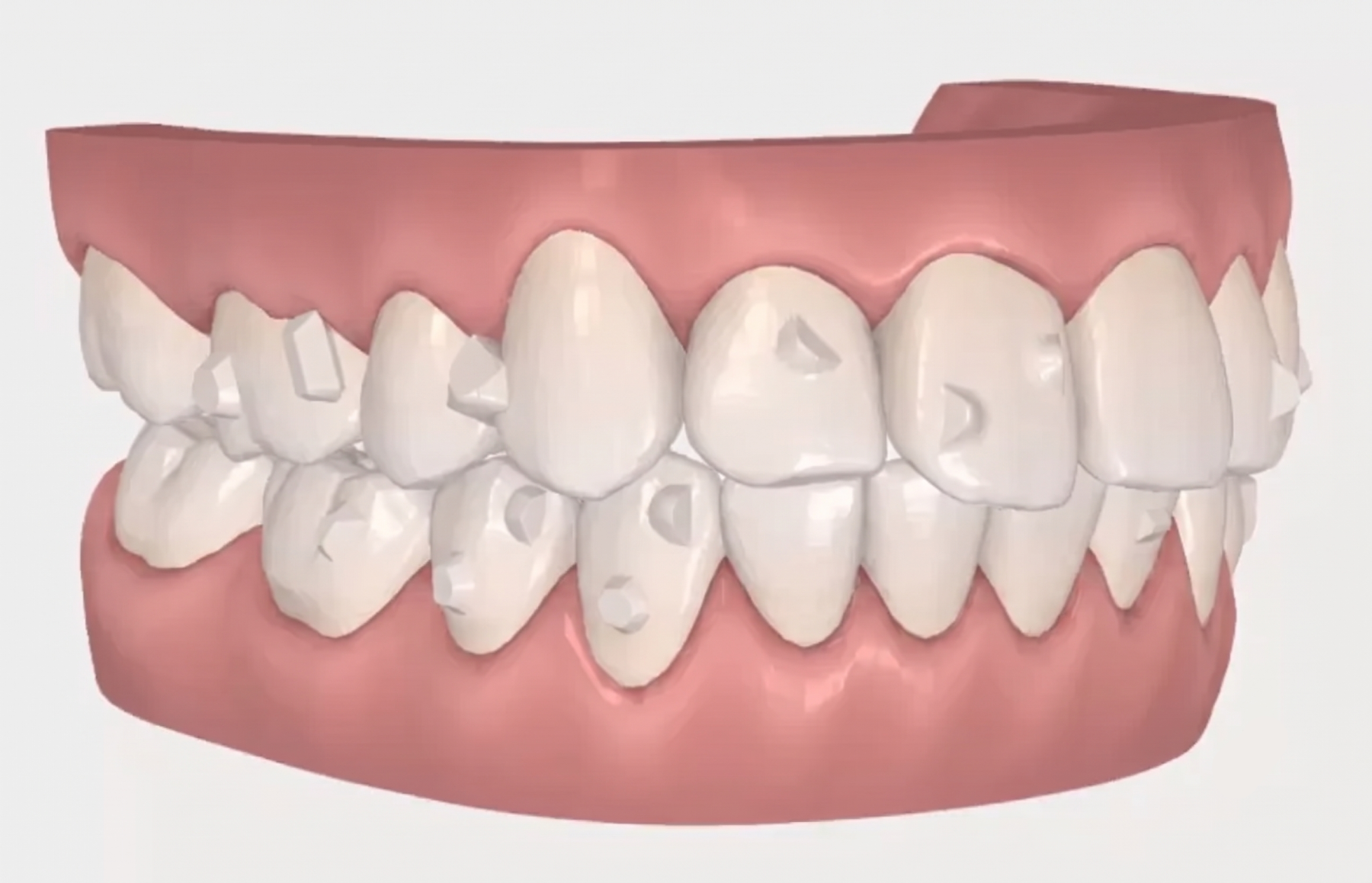
Not every treatment needs the same number of attachments. A mild case treated with Invisalign i7, for example, may need few or none. A moderate or complex case — involving canine rotation or bite correction — usually needs several attachments placed across different teeth. Dr. Lanuza determines the number and exact position of each one during the initial 3D scan diagnosis, before any aligner is manufactured.
What role do attachments play in each type of tooth movement?
Every dental movement requires a different type of anchorage, which is why attachments come in different shapes and orientations. A tooth that needs to rotate on its own axis — typical of canines and premolars, given their cone-like shape — requires an attachment that resists twisting, something the aligner’s smooth plastic can’t provide on its own. A tooth that needs to extrude, moving down from the bone towards the biting plane, needs an attachment the aligner can hook onto to pull it downward, a movement simple pressure can’t achieve.
Intrusion — pushing a tooth up into the bone, common in deep-bite cases — and root torque, tipping the root rather than just the crown, are the movements that demand the greatest biomechanical precision, and therefore depend most heavily on a correctly designed attachment. The ClinCheck software calculates mathematically which combination of shape, size and angle generates the exact force needed for each specific movement, tooth by tooth.
There are also attachments designed specifically to anchor intermaxillary elastics in bite-correction treatments (Class II and III cases), and larger attachments designed purely to help patients seat and remove aligners without effort in cases with a particularly tight fit. This variety explains why two Invisalign patients can end up with completely different numbers and shapes of attachments, even under the same treatment system.
Types of Invisalign attachments by tooth movement
Align Technology catalogues attachments by their geometric shape and the type of force they’re designed to transmit. Dr. Lanuza selects the right type for each tooth within the ClinCheck treatment plan.
| Attachment type | Shape | Movement it enables |
|---|---|---|
| Rectangular | Elongated, horizontal ridge | Rotation of rounded teeth such as canines and premolars |
| Beveled (optimised) | Built with a calculated angle | Extrusion — vertical downward movement of the tooth |
| Deep beveled | Steeper angle than the standard bevel | Root torque — tipping the tooth root |
| Ellipsoid | Oval, smooth edges | Anchoring intermaxillary elastics for bite correction |
| Insertion-assist | Larger volume than the rest | Making aligner seating and removal easier on tight fits |
Combining several types within the same mouth is the norm, not the exception. A patient might wear rectangular attachments on the canines, beveled ones on a premolar and ellipsoid ones on a back molar, all within the same treatment plan and all aimed at giving each tooth exactly the force it needs at each stage.
How Invisalign attachments are placed
The placement process starts long before the patient sits down for the procedure itself: the ClinCheck software designs the position, shape and orientation of every attachment as part of the full digital treatment plan — the same 3D simulation that maps each tooth’s movement from the first aligner to the last. That digital template is then translated into a custom-made clear resin guide called a SmartForce template.
In the chair, Dr. Lanuza seats that template over the arch — it has openings exactly where each attachment needs to go. Tooth-coloured composite is applied through those openings in the precise amount required. A curing light hardens the material in seconds, and once the template is removed, the attachment is left fixed in the exact position the digital plan calculated weeks earlier.
The whole procedure is done in a single visit and doesn’t require anaesthesia, since it doesn’t invasively affect the enamel or reach the pulp. Patients may notice a slightly different texture with their tongue for the first few days, a sensation that fades with familiarity. This same appointment usually coincides with handing over the first set of aligners in the series, so active treatment begins the same day.
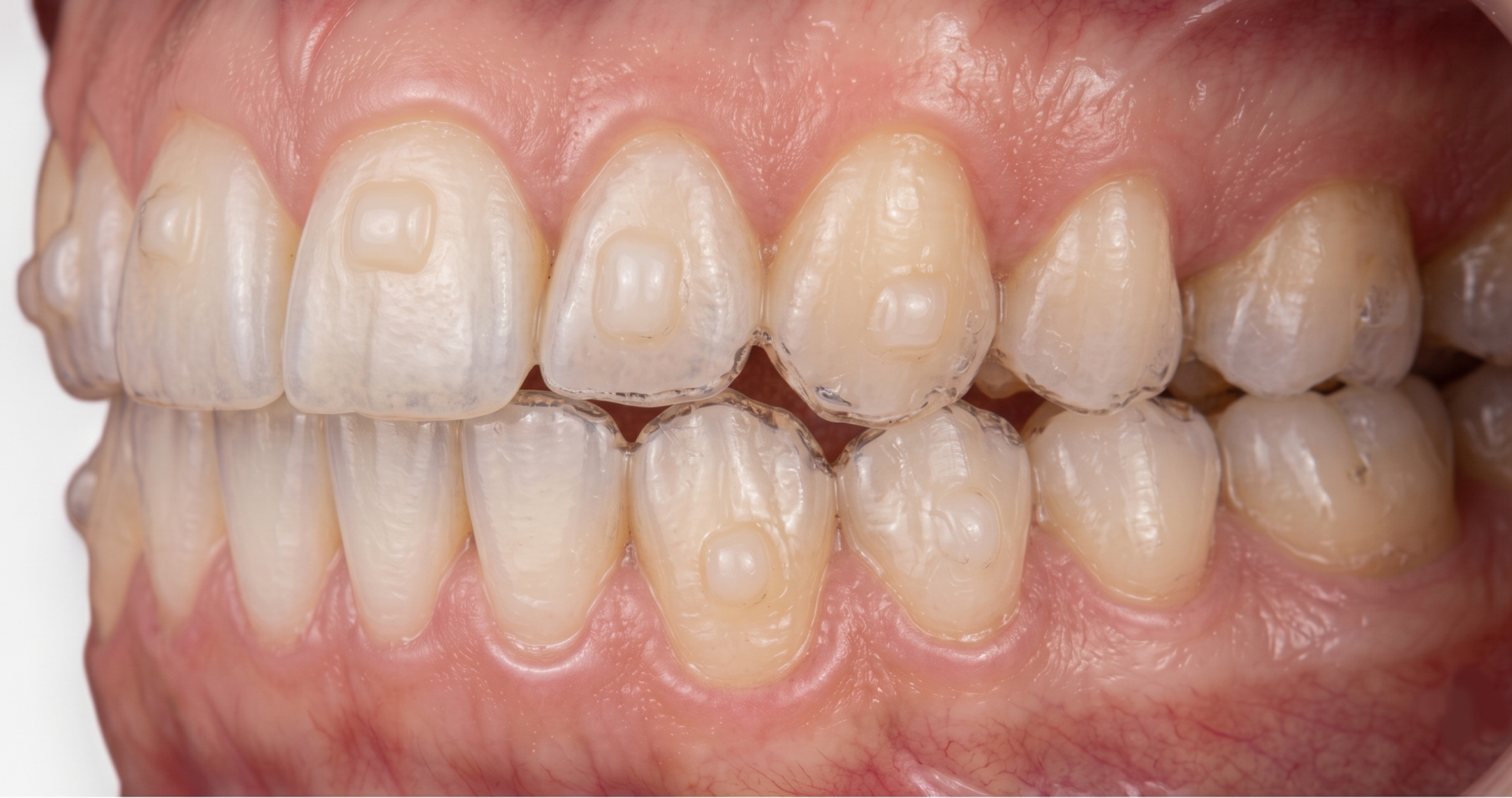
Do Invisalign attachments show? Aesthetics and visibility
One of the reasons Invisalign is such an attractive alternative to fixed braces is its discretion, and attachments are specifically designed not to compromise that. The composite is shade-matched to the natural tooth colour, and its size rarely exceeds 3-4 millimetres. At normal conversational distance, most people don’t notice an attachment unless they’re looking for one.
Attachment visibility depends more on the thickness of the aligner covering it than on the attachment itself: under the clear plastic, the bump appears as a faint shadow or small bulge, more noticeable to the tongue than to the eye. When the patient removes the aligner to eat or for a photo, the attachment is exposed similarly to a small natural imperfection in the enamel — a very different level of visibility than a metal bracket.
| Aspect | With attachments | Without attachments |
|---|---|---|
| Movement precision | High for rotations, extrusions and root torque | Limited to simple tipping movements |
| Indicated cases | Moderate and complex, Invisalign Lite and Full | Mild cases, Invisalign i7 |
| Aligner retention | Stronger grip, less plastic play | Sufficient for minimal movements |
| Visibility | Minimal, tooth-coloured relief | None, smooth tooth surface |
Care, duration and what to do if an attachment comes off
Attachments don’t stay in the same position throughout the whole treatment: the ClinCheck software can plan for an attachment to be removed and repositioned elsewhere on the tooth halfway through treatment, depending on the movement phase that tooth is in. That’s why Dr. Lanuza often schedules follow-up visits to remove, reposition or add attachments as the aligner series progresses, always following the sequence set out in the initial digital plan.
Cleaning around an attachment doesn’t require special products, but it does need more careful brushing — the raised surface can trap plaque if the contour isn’t brushed thoroughly. An electric toothbrush along with floss or interdental brushes noticeably reduces that risk. The composite used is a durable material, similar to that used in cosmetic fillings, and it doesn’t stain or wear down under normal aligner use over months of treatment.
If an attachment comes off partially or fully between visits — uncommon but possible, especially with very hard or sticky foods — the recommendation is to keep wearing the aligner as normal and contact the clinic to have it rebonded at the next available appointment, without waiting for the scheduled review if treatment is several stages behind. A missing attachment doesn’t stop tooth movement immediately, but if it goes unreplaced for several weeks, it can reduce the precision of the planned movement for that tooth.
Invisalign attachments and the importance of a Diamond Provider
Attachment position is measured in fractions of a millimetre, and a placement error — however small it seems — can mean the tooth doesn’t receive exactly the force the software calculated, requiring additional refinement aligners later to correct the deviation. This is one of the reasons a specialist’s experience has such a direct effect on the outcome of Invisalign treatment.
Invisalign certifies its providers based on case volume, from Silver to Diamond. Dr. Lanuza has been a Diamond Provider since 2016 and has completed over 1,000 cases, giving him a consolidated command of SmartForce template placement and of when an attachment plan needs adjusting from the software’s automatic proposal before the aligners are manufactured.
That experience translates into fewer refinement aligners, more predictable treatments and fewer visits to reposition poorly placed attachments. To learn more about what this certification means, read our article on the Invisalign Diamond Provider in Valencia, or check the pros and cons of invisible orthodontics before deciding on your treatment.
Price of attachments within Invisalign treatment
Attachments aren’t billed as a separate service — they’re part of the overall Invisalign treatment plan, and their cost is already included in the general quote, with no per-unit charges or extra fees for rebonding visits during treatment. The final treatment price depends on the modality — i7, Lite or Full — and case complexity, not on how many attachments a given patient needs.
At Asensio Dental Clinic we offer interest-free financing to spread the cost of the full treatment. You can check detailed pricing for Invisalign and all orthodontic treatments, or request a personalised quote at your first consultation, where Dr. Lanuza will assess whether your case needs attachments and on which teeth.
Frequently asked questions about Invisalign attachments
How long do you wear Invisalign attachments?
It depends on the treatment plan: some attachments stay in place for the whole treatment, while others are removed and rebonded elsewhere on the tooth halfway through, as set out in the digital ClinCheck plan. Dr. Lanuza determines this sequence before treatment begins.
Do Invisalign attachments hurt when they’re placed or worn?
Placement doesn’t require anaesthesia or cause pain, since it doesn’t invasively affect the enamel. It’s normal to notice a slightly different texture with the tongue for the first few days — this doesn’t interfere with chewing or speech and fades with familiarity.
Can attachments be removed at some point during treatment?
Yes. The ClinCheck software can plan for an attachment to be removed once it has served its purpose and, if the next movement requires it, repositioned elsewhere on the tooth. This is done in the chair using the same SmartForce template procedure as the initial placement.
What happens if an Invisalign attachment falls off?
You can keep wearing the aligner as normal and should contact the clinic to have it rebonded at the next available appointment. A missing attachment doesn’t stop treatment immediately, but if it goes unreplaced for several weeks, it can reduce the precision of the planned movement for that tooth.
Does every Invisalign patient need attachments?
No. Mild cases treated with Invisalign i7, for example, may need few or no attachments. Moderate and complex cases involving rotations, extrusions or bite correction usually do require them to achieve the planned movement with precision.
Do attachments stain or come loose with normal aligner use?
The composite used is a durable material, similar to that used in cosmetic fillings, and it doesn’t stain or wear down under normal use. Spontaneous debonding is uncommon and is usually linked to very hard or sticky foods eaten without removing the aligner first.