 96 382 55 77


Dental stripping, also known as IPR (Interproximal Reduction), is the orthodontic technique that removes a controlled, thin layer of enamel from the side surface of the teeth to create the millimetre-level space a treatment needs, without resorting to an extraction.
If your orthodontist has mentioned stripping and you’re worried that “filing” a tooth might be harmful or irreversible, that’s a completely understandable reaction: enamel doesn’t regenerate, and the idea of touching it raises legitimate long-term safety questions. The good news is that, when properly planned, IPR works within very strict clinical margins backed by decades of scientific evidence.
At Asensio Dental Clinic we are an official Invisalign Diamond centre in Valencia. Dr. José Luis Lanuza (Registration No. 46002399), certified in the Invisalign system since 2002 with over 1,000 cases completed, plans every interproximal reduction to a millimetre-precise margin for each tooth and case. Your first visit is free.
What Dental Stripping (IPR) Is
Dental stripping reduces the thickness of enamel at the contact point between two neighbouring teeth, usually in the incisors, canines and premolars. The orthodontist applies the reduction exclusively to the proximal surface — the side surface touching the adjacent tooth — never to the visible or biting surface.
The technique relies on a simple biological principle: enamel in the interproximal areas of the front teeth measures between 0.3 and 1.2 mm thick, and only a fraction of that thickness — typically 0.2 to 0.5 mm per surface, depending on the tooth — can be removed without compromising the tooth’s structure or health. The orthodontist measures that margin before treating, using X-rays or the intraoral scanner, which shows the actual enamel thickness available at each contact point.
The result of stripping isn’t just space: it also slightly reshapes the tooth, narrowing the contact point and, in many cases, improving the width-to-height ratio of the clinical crown — an effect orthodontists also use for aesthetic purposes, not only to gain millimetres.
The term IPR coexists with other names for the same procedure: interproximal reduction, interproximal stripping, or reproximation. All refer to the same clinical step, the only difference being that “stripping” is the term more commonly used by patients, while “IPR” is preferred by orthodontists in clinical records and in the digital planning of Invisalign in Valencia, where the software calculates the IPR needed tooth by tooth before manufacturing the aligners.
What IPR Is Used For in Orthodontics
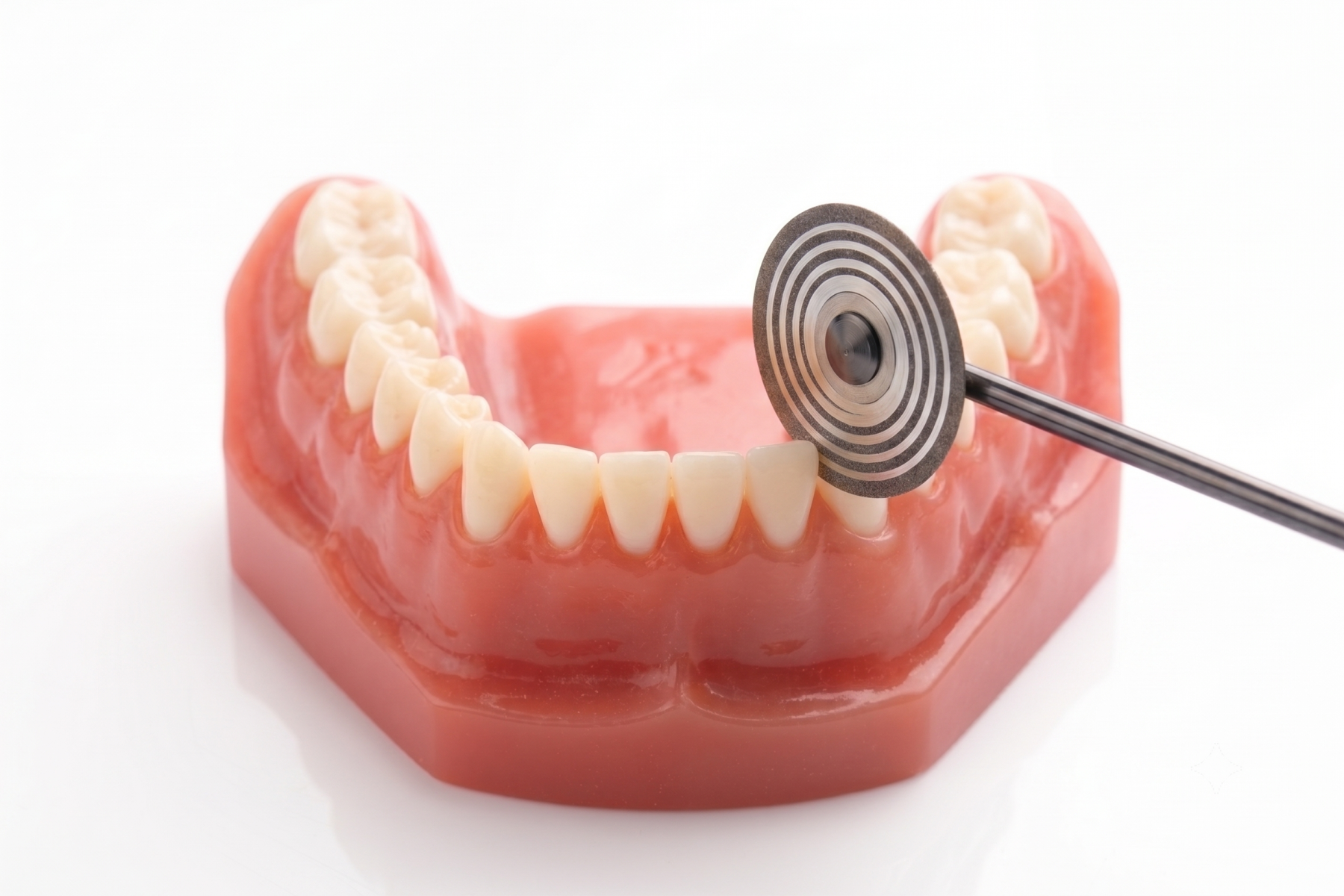 IPR solves one specific problem: lack of space in the dental arch without extracting any tooth. When crowding is mild to moderate — usually up to 4-5 mm of total arch discrepancy — stripping distributed across several teeth frees up enough space to align the arch without sacrificing a single healthy tooth.
Orthodontics in Valencia relies on IPR in several distinct clinical scenarios. The first is mild dental crowding, where spreading 0.2-0.3 mm of reduction across six to eight contact points generates several millimetres of total space without expansion or extraction. The second is correcting tooth shape: teeth with very wide contact points or triangular shapes benefit from selective stripping that improves the final aesthetics of the smile. The third is adjusting the dental midline, where asymmetric IPR between one side of the arch and the other corrects small centring discrepancies. The fourth is preventing relapse: reducing the contact point on teeth with very convex anatomy lowers the tendency to crowd again after the orthodontic appliance is removed.
IPR also plays a relevant role in clear aligner treatments, where digital planning software automatically distributes the millimetres of stripping needed across different contact points to minimise the wear per tooth. This planned distribution is one of the reasons why invisible orthodontics achieves predictable results with less need for extractions than a decade ago.
Not every case is a candidate: when the space discrepancy exceeds 6-7 mm, IPR alone isn’t enough, and the orthodontist will consider combining it with expansion, distalisation or, as a last resort, extraction.
How the Procedure Is Performed Step by Step
The orthodontist carries out stripping in several stages within the same appointment, always with topical anaesthetic available, although it’s rarely needed. First, the teeth are gently separated with a wedge or separator to access the contact point without damaging the gum. Next, the reduction instrument — a metal abrasive strip, a fine-grit motorised disc, or a low-speed diamond bur, depending on the case — is used to wear down the enamel in short, controlled passes, checking the remaining thickness with a specific gauge after each pass.
Once the calculated space is reached, the specialist polishes the surface with progressively finer discs to remove any roughness and applies a topical fluoride treatment that remineralises the exposed area and reduces post-treatment sensitivity. Finally, a protective sealant or varnish is applied in cases where the enamel is left more exposed, and dental floss is used to check that the contact point maintains proper closure between both teeth.
The entire procedure is planned before active treatment begins: in digital aligner plans, the software determines at which stage of the sequence each IPR should be performed, and the orthodontist spreads it across two or three appointments throughout the treatment rather than concentrating it all at the start, which reduces cumulative sensitivity and allows the actual need for space to be reassessed as tooth movement progresses.
Is Dental Stripping Safe? Myths About Enamel Wear
The most common fear among patients is that reducing enamel will permanently weaken the tooth or increase the risk of cavities. The clinical evidence gathered over more than thirty years of using this technique does not support that fear when the procedure respects established limits: the amount of enamel removed in a well-planned IPR remains well below the threshold that would compromise the tooth’s mechanical resistance or expose the dentine.
The real risk lies not in stripping itself, but in performing it without controlling the thickness: excessive or poorly distributed wear can expose the dentine, permanently increase sensitivity and indeed raise the risk of cavities on that surface due to the increased roughness. That’s why using a measuring gauge on every pass — rather than estimating by eye — is what separates safe IPR from poorly executed IPR, and it’s also why this technique must always be performed by an orthodontist with specific training rather than delegated to auxiliary staff.
The final polishing and fluoride application after the wear serve a purpose many patients aren’t aware of: they remineralise the exposed surface and reduce its porosity, leaving it with cavity resistance equivalent to the adjacent untreated enamel. Long-term follow-up studies on patients treated with IPR show no significant increase in interproximal decay or periodontal problems attributable to the procedure, provided the correct technique is followed and the patient maintains proper interdental hygiene during and after treatment.
Does Dental Stripping Hurt? Discomfort and Sensitivity
Dental stripping doesn’t require anaesthesia in the vast majority of cases, because enamel has no nerve endings: the patient feels vibration and pressure, not pain, during the procedure. The sensation is comparable to a prolonged professional cleaning in that specific area.
The real discomfort, when it occurs, doesn’t happen during the appointment but in the hours afterwards: some patients report mild sensitivity to cold or sweet foods for a day or two, caused by the temporary exposure of very superficial dentinal tubules before the applied fluoride completes its remineralising effect. This sensitivity is self-limiting and disappears without treatment in nearly all cases.
A second type of discomfort, distinct from sensitivity, is the feeling of “food getting stuck” between the teeth during the first few days after IPR, while the contact point readjusts along with the orthodontic movement. This doesn’t indicate any problem: it’s simply the expected result of having slightly changed the contact geometry between both teeth, and it resolves as the aligners or braces complete the planned movement.
If sensitivity lasts more than a week, intensifies instead of fading, or spontaneous pain appears without a stimulus, these are signs that a check-up is needed, as they could indicate wear beyond what was planned or dentine exposure requiring additional sealing.
Dental Stripping vs. Tooth Extraction: Differences and When to Choose Each Option
The choice between IPR and extraction fundamentally depends on the extent of the crowding and the patient’s facial profile, and it’s one of the most important clinical assessments the orthodontist makes during diagnosis.
| Criterion | Dental Stripping (IPR) | Tooth Extraction |
|---|---|---|
| Space generated | Up to 4-5 mm spread across several points | 7-8 mm or more per extracted tooth |
| Main indication | Mild-to-moderate crowding | Severe crowding or marked biprotrusion |
| Reversibility | Not reversible, but the tooth keeps full function | Permanent, requires orthodontic space closure |
| Impact on facial profile | Practically none | Can retract the profile if several teeth are extracted |
| Treatment duration | Usually doesn’t extend it | May extend it due to space closure |
| Associated discomfort | Mild, temporary sensitivity | Surgical aftercare with swelling |
The orthodontist doesn’t treat IPR and extraction as interchangeable options: they’re tools for problems of different magnitude. Reducing enamel in a case that genuinely needs extraction only delays the correct diagnosis, and extracting in a case solvable with stripping removes healthy teeth unnecessarily. Analysing the facial profile, incisor position and model discrepancy determines which route is right for each patient, and this is usually decided during digital planning before starting treatment with Invisalign in Valencia or fixed braces.
Aftercare Following Dental Stripping
Aftercare following IPR is simple but directly determines the long-term outcome of the technique. Using dental floss or interdental brushes in the treated area becomes mandatory, not optional: the modified contact point tends to retain more bacterial plaque until the adjacent tooth moves into its final position, and skipping interdental cleaning in those days is the most common cause of prolonged sensitivity.
Extreme temperatures — very cold or very hot drinks — should be avoided for the first 48 hours while the applied fluoride completes its remineralising effect on the exposed surface. Brushing should continue as normal, preferably with a standard-strength fluoride toothpaste, without needing special products unless the orthodontist specifically advises otherwise.
Regular treatment check-ups are also when the specialist confirms the contact point is developing as planned and that no unwanted residual gap has appeared between the treated teeth. In aligner treatments, each new set of clear aligners incorporates the adjustment corresponding to the reduction already performed, so following up at every appointment is an integral part of post-IPR care.
In the long term, once orthodontic treatment is complete, a tooth treated with stripping needs no different care from the rest of the dentition: maintaining regular interdental hygiene and routine dental check-ups is enough to keep the result stable.
Check the price of orthodontics in Valencia to find out whether IPR is included in your treatment plan.
Frequently Asked Questions About Dental Stripping (IPR)
How many times can stripping be done on the same tooth?
The orthodontist typically spreads the total IPR needed across two or three sessions throughout treatment rather than concentrating it in a single appointment, always respecting the accumulated enamel limit that can safely be removed at that specific contact point. Exceeding that accumulated limit does compromise the tooth surface, which is why the specialist records the remaining thickness before considering any further reduction.
Does dental stripping create gaps between teeth?
No, if the treatment is completed correctly. The space created by IPR progressively closes as the aligners or fixed appliance move the teeth into their final planned position. A visible gap only remains if treatment is interrupted before the planned movement is completed.
Can stripping be done without orthodontics?
IPR is always performed within an active orthodontic treatment, never as a standalone procedure, because its purpose is to create space for planned tooth movement. Doing it without a subsequent movement plan would leave permanent gaps between teeth with no functional or aesthetic benefit.
Does stripping affect baby teeth or only permanent teeth?
IPR is applied exclusively to permanent teeth with fully formed roots. In children’s orthodontics with mixed or primary dentition, the orthodontist uses other space-creation strategies, such as space maintenance or expansion, instead of interproximal reduction.
How long does each dental stripping appointment take?
Each IPR session usually takes between 15 and 30 minutes, depending on the number of contact points worked on at that appointment, and it’s normally carried out as part of a routine orthodontic check-up without needing a separate specific appointment.