 96 382 55 77


Rotary endodontics is the treatment of a tooth’s root canals using nickel-titanium files powered by an electric motor. This allows for cleaning and sealing the interior of the infected tooth with greater precision, in less time, and with a higher success rate than conventional manual endodontics.
Many patients associate root canals with pain and failure. In reality, the pain is caused by the infection, not the treatment; with current techniques, endodontics is performed under full local anesthesia without any discomfort. The fear of root canals often leads to delaying treatment until the infection spreads and the tooth can no longer be saved — that is the true problem.
At Asensio Dental Clinic, Dr. Lucía Asensio Romero (Registration No. 46002287) performs endodontics using a ZEISS microscope and FOX III laser, with a 99% success rate. The first visit is completely free of charge.
When is a root canal necessary?
Endodontics is indicated when the dental pulp —the soft tissue inside the tooth containing nerves and blood vessels— is infected or necrotic. This occurs when deep decay reaches the pulp, when the tooth has suffered trauma that damaged the internal tissues, or when a previous restoration has leaked, allowing bacteria to enter. Pulpal infection does not resolve spontaneously: it progresses until it destroys the tissue, spreads to the periapical bone forming an abscess, and can compromise the tooth’s vitality.
Symptoms indicating the need for a root canal include spontaneous pain or pain triggered by stimuli —cold, heat, pressure— that does not subside or lasts longer than usual, sensitivity to pressure when biting, the tooth changing color toward grayish or brownish tones, swelling in the adjacent gum or face, and the appearance of a “pimple” or fistula on the gum that releases pus. In some cases, the pulp becomes necrotic without producing noticeable symptoms, and the lesion is discovered during a routine X-ray.
How rotary endodontics is performed at Asensio Dental Clinic
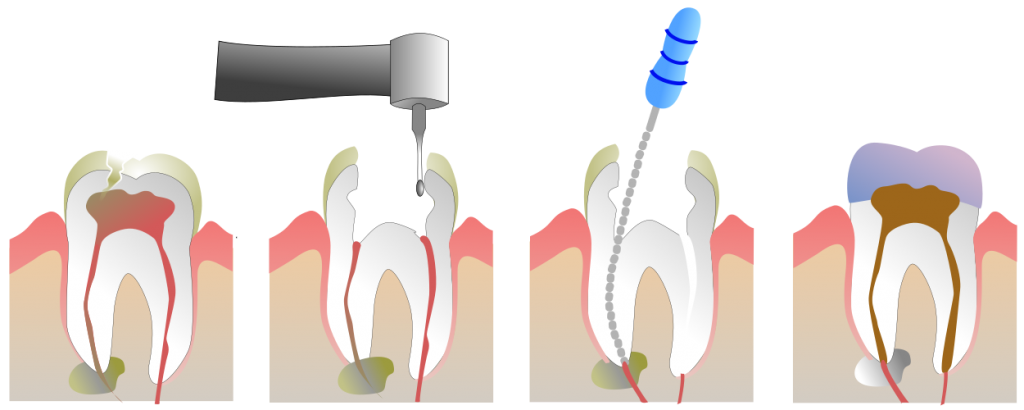
The procedure begins with the administration of local anesthesia to ensure the patient feels no discomfort throughout the treatment. The tooth is isolated with a rubber dam to maintain a sterile field, and access to the interior of the tooth is gained by drilling through the crown. Using the ZEISS microscope, we identify all root canals —molars can have up to four— and instrument them with the nickel-titanium files of the rotary system, which progressively clean and shape the canal.
Irrigation with sodium hypochlorite and EDTA removes organic debris and demineralizes the canal walls, facilitating disinfection. The FOX III laser has a bactericidal power far superior to conventional irrigators: it acts on bacteria lodged in the dentinal tubules that chemical irrigants cannot reach. Once the canals are clean, shaped, and disinfected, they are sealed with gutta-percha and sealing cement up to the root apex to prevent reinfection. Finally, the tooth is restored with a composite reconstruction or prepared for a protective crown.
| Type | Canals | Affected Teeth |
|---|---|---|
| Single-rooted (Uniradicular) | 1 root, 1 canal | Incisors and canines |
| Double-rooted (Biradicular) | 2 roots, 2 canals | Premolars |
| Multi-rooted (Poliradicular) | 3 or more roots and canals | Molars |
This specialty is part of our other dental treatments in Valencia area.
Frequently Asked Questions about rotary endodontics
What are the symptoms indicating the need for a root canal?
Spontaneous pain or pain from stimuli that does not go away, prolonged sensitivity to cold or heat, tooth discoloration, swelling in the gum or face, or the appearance of a fistula. In some cases, there are no symptoms, and the lesion is detected on an X-ray. When in doubt, a clinical examination with an X-ray is the only valid diagnosis.
What happens when the dental pulp is damaged?
Necrotic or infected pulp cannot regenerate. The bacteria colonizing it produce toxins that destroy periapical tissue, forming a granuloma or an abscess in the bone. Without treatment, the infection spreads, potentially causing tooth loss and compromising the patient’s general health.
How long does a root canal-treated tooth last?
A tooth that has been correctly treated with endodontics, restored with a reconstruction or protective crown, and maintained with proper hygiene can last the patient’s entire life. A root canal does not weaken the tooth more than it was already weakened by the decay or trauma that caused it — what weakens it is the loss of tooth structure, which is why subsequent restoration is essential.
Is it necessary to place a crown after a root canal?
It depends on the degree of tooth destruction. If the loss of structure is severe, a crown is essential to protect the tooth from fractures. If the destruction is limited and enough tooth walls remain, a composite reconstruction or a ceramic inlay may suffice.
If you have questions about the procedure, read our guide on what is a root canal and how it is performed.