 96 382 55 77


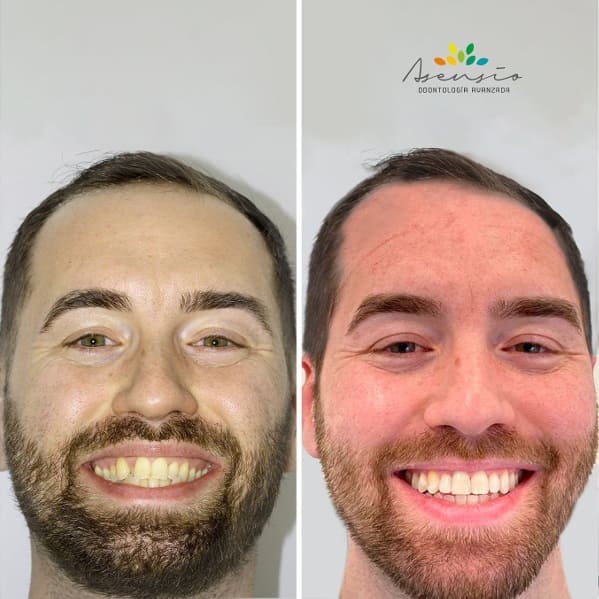
Invisible orthodontics before and after results are one of the most sought-after criteria for patients considering treatment. Seeing real cases resolved with clear aligners provides a realistic idea of what the treatment can achieve and in which clinical situations it is most effective.
However, before-and-after cases typically published on clinic websites often show only the most spectacular results, which can generate unrealistic expectations. Knowing which types of cases yield the best results and which have limitations is as important as seeing the photos.
At Asensio Dental Clinic, we are an official Invisalign Diamond center in Valencia with over 1,000 cases completed. Dr. José Luis Lanuza (Registration No. 46002399) has been certified in the system since 2002 and has treated virtually all variants of malocclusion manageable with aligners. On this page, you will find real before-and-after cases, the types of problems best resolved with invisible orthodontics, and how the digital planning process works.
Invisible Orthodontics Before and After Cases
The most frequent cases we treat with Invisalign at Asensio Dental Clinic and the typical results obtained are as follows:
| Case Type | Before | After |
|---|---|---|
| Dental Crowding | Overlapping teeth with little space, making hygiene difficult and affecting aesthetics. | Teeth aligned in their correct position, improving aesthetics and facilitating brushing and flossing. |
| Diastemas (Gaps) | Excessive spaces between teeth affecting aesthetics and potentially causing food impaction. | Closing of spaces for a more uniform and functional smile. |
| Crossbite | Upper teeth biting inside the lower teeth, causing tooth wear and TMJ issues. | Balanced and functional bite that improves oral health and facial appearance. |
| Overbite | Upper teeth excessively covering the lower teeth when closing, causing wear and functional issues. | Correct arch relationship that eliminates premature wear and improves chewing function. |
| Open Bite | Front teeth do not touch when the mouth is closed, affecting chewing and speech. | Correct bite closure that restores chewing function and improves smile aesthetics. |
How Patients See Their Results Before Starting
One of the most valued advantages of invisible orthodontics over braces is the ability to see the final result before starting treatment. Invisalign’s ClinCheck software generates a 3D simulation of every tooth’s movement throughout the treatment, showing how the smile will look at the end.
This simulation is reviewed during the first consultation with Dr. Lanuza, who explains each phase and can adjust the plan if the patient has specific preferences. It is the only orthodontic system that allows this prior interaction between the patient and the orthodontist regarding the outcome before any aligners are manufactured.
The simulation is not an exact guarantee — actual movement may differ slightly — but it is a highly useful tool for aligning patient expectations with the real clinical possibilities of the case.
Which Cases Have Better Results with Invisible Orthodontics?
Invisible orthodontics offers its best results in cases of mild to moderate crowding, diastemas, dental crossbites, and overbites with a dental component. In these cases, results are equivalent to those obtained with fixed braces, with the added advantages of discretion and comfort.
More complex cases — skeletal malocclusions, extreme dental rotations, or the need for very precise intrusion movements — may require fixed braces or a combination of orthodontics with orthognathic surgery for optimal results. With over 1,000 cases completed, Dr. Lanuza has the experience to determine during the initial diagnosis if the case is suitable for Invisalign or if another system would offer better results.
If you want to know if your case is treatable with invisible orthodontics, the first consultation at Asensio Dental Clinic is free and includes a 3D scan, digital X-ray, and a simulation of the final result without commitment. Also, check the advantages and disadvantages of invisible orthodontics for a complete overview before deciding.
Frequently Asked Questions about Invisible Orthodontics Before and After
When do you start noticing results from invisible orthodontics?
The first visible changes are usually seen between four and eight weeks of treatment, depending on case complexity and the type of movement. Mild crowding cases often show faster changes than bite correction cases. At the end of each aligner stage, the patient can compare their current position with the initial simulation to see progress.
Are invisible orthodontics results permanent?
Results are stable long-term if retention instructions are followed correctly at the end of treatment. After removing the aligners, a retainer — removable or fixed — is placed to maintain the position. Without retention, teeth have a natural tendency to partially return to their original position, regardless of the system used.
Can I see real before-and-after cases from the clinic?
Yes. During the free first consultation, Dr. Lanuza shows real clinical cases treated at the clinic similar to yours, in addition to the personalized 3D simulation for your specific case. You can also check patient testimonials on our testimonials page and on our Google profile.
Are Invisalign results the same as those from braces?
For cases where Invisalign is indicated — mild to moderate malocclusions — results are clinically equivalent to fixed braces. The difference lies in the treatment experience, not the final result. For highly complex cases, fixed braces may offer a higher level of three-dimensional control over dental movement.