 96 382 55 77


A tooth extraction — also known as exodontia — is the clinical procedure by which a tooth is removed from its bony socket in a controlled manner under local anaesthesia. It is the most frequently performed dental procedure worldwide and, when carried out correctly, is a virtually painless process that in most cases takes between 5 and 20 minutes.
If your dentist has told you that you need a tooth taken out and the word “extraction” is causing you anxiety, that is completely understandable. Fear of tooth extraction is one of the most widespread in dentistry, and in most cases it is based on past experiences or what others have described. Understanding exactly what is going to happen — before, during and after — is the best way to approach it with confidence.
At Asensio Dental Clinic, Dr. Lucía Asensio Romero (Registration No. 46002287) performs simple and surgical extractions using minimally invasive protocols and maximum patient comfort. The first visit is completely free and includes a full clinical examination, digital X-ray and diagnosis.
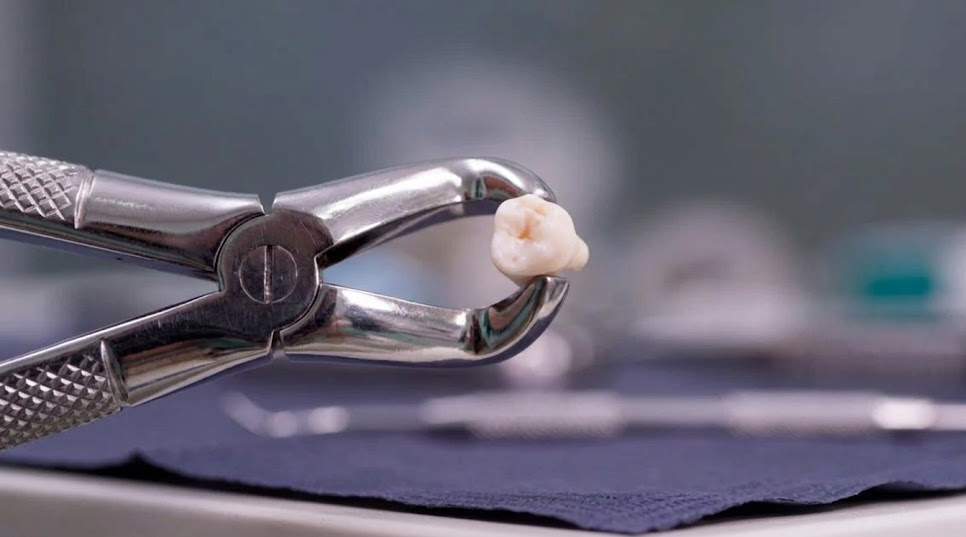
What is a tooth extraction and when is it necessary
The term exodontia derives from the Greek ex (out) and odont (tooth), and specifically refers to the extraction of a tooth or molar from the alveolus — the bony socket in which it sits. Contrary to what many patients fear, the extraction itself does not cause pain because it is performed under local anaesthesia that completely blocks the sensation of pain: what is felt during the procedure is pressure and movement, not pain.
Extraction is never the first resort but the last: it is only indicated when there is no viable conservative alternative to keep the tooth in the mouth with function and health. The main indications are the following.
Advanced decay with no possibility of restoration is the most frequent cause of extraction: when the destruction of the crown and root is so extensive that it cannot be rebuilt with a filling or a crown, extraction is the only option. Advanced periodontal disease with severe tooth mobility — when supporting bone has been lost to the point where the tooth can no longer be maintained in position — is the second most common cause.
Wisdom teeth in an incorrect position that cause pain, repeated infections, damage to the adjacent tooth or cysts are extracted on a scheduled basis. Retained or impacted teeth that have not erupted and are generating pathology require surgical extraction. In advanced periodontics, in orthodontics to create space in crowded arches, or following trauma with untreatable root fractures, extraction is equally the correct indication.
Types of tooth extraction: simple and surgical
Not all extractions are the same. The type performed depends on the accessibility of the tooth, its position, the condition of the root and the anatomical complexity of each case. Understanding the difference between a simple and a surgical extraction helps the patient know what to expect and what recovery time is realistic.
Simple or conventional extraction
A simple extraction is performed when the tooth is fully visible in the mouth, has an accessible clinical crown and its roots show no dilacerations, ankylosis or proximity to anatomical structures at risk. The procedure consists of luxation of the tooth — controlled expansion movements of the socket that relax the periodontal ligament fibres — followed by the traction that removes it from the alveolus.
With correctly applied local anaesthesia, a simple extraction is virtually painless. The typical duration is between 5 and 15 minutes from the application of anaesthesia to suturing of the socket if required. Post-operative recovery is rapid: in most patients discomfort disappears within 24–48 hours with conventional oral analgesia.
Surgical or complex extraction
Surgical extraction is indicated when the tooth cannot be removed by conventional means: impacted or semi-retained wisdom teeth, root fragments within the bone, ankylosed teeth — fused to the bone without a periodontal ligament — or teeth with very complex root morphology. In these cases it is necessary to make an incision in the gum, raise a soft tissue flap, perform bone removal to free the tooth and, frequently, section the tooth into fragments to facilitate removal in pieces.
The most complex cases — lower wisdom teeth in a horizontal position close to the inferior alveolar nerve, roots very close to the maxillary sinus, or situations of increased systemic risk — are referred to the Oral and Maxillofacial Surgery Unit, where they are performed with the appropriate resources and monitoring, sometimes under conscious sedation.
| Feature | Simple extraction | Surgical extraction |
|---|---|---|
| Tooth visible in mouth | Yes | Not always |
| Gum incision | No | Yes |
| Bone removal | No | Sometimes |
| Tooth sectioning | No | Common |
| Approximate duration | 5–15 min | 20–60 min |
| Recovery | 24–48 hours | 3–7 days |
| Sutures | Not always | Usually yes |
How a tooth extraction is performed step by step
Knowing exactly what will happen during the extraction is one of the most effective ways to reduce pre-operative anxiety. The process always follows the same main phases, although the duration and instruments used vary depending on the type of extraction.
Step 1 — Diagnosis and planning: before any extraction, a periapical or panoramic X-ray is taken to assess root morphology, the relationship with adjacent structures — inferior alveolar nerve, maxillary sinus, neighbouring teeth — and to plan the safest approach. In complex cases this is supplemented with a dental CBCT scan to obtain a complete three-dimensional image.
Step 2 — Local anaesthesia: topical anaesthetic gel is applied to the gum to reduce the initial injection sensation, followed by the local anaesthetic infiltration. Full anaesthetic effect is reached within 2–5 minutes. It is important to tell the dentist if any painful sensation is felt during the extraction — the anaesthesia can be supplemented at any point.
Step 3 — Syndesmotomy and luxation: with the tooth anaesthetised, the dentist inserts a thin instrument — the syndesmotome — between the tooth and the gum to separate the periodontal ligament fibres. Using an elevator and forceps, controlled luxation movements progressively expand the socket and relax the remaining ligament until the tooth can be removed without resistance.
Step 4 — Extraction and socket curettage: once the tooth is removed, the socket is curetted to eliminate granulation tissue remnants, root fragments or pathological tissue. Resorbable sutures are placed if needed to approximate the gum edges and promote healing.
Step 5 — Bleeding control: a gauze pad is placed over the socket for the patient to bite on for 30–60 minutes. Clot formation during this time is the first step in healing. Post-operative instructions — what to do and what to avoid in the first hours and days — are always provided in writing.
Does a tooth extraction hurt
During a correctly anaesthetised extraction, no. Local anaesthesia completely blocks pain transmission: what is felt is pressure, vibration and movement — sensations that may be uncomfortable but are not painful. The main cause of pain in patients who have had bad experiences is insufficient anaesthesia, something that can be resolved at any point by supplementing the dose during the procedure.
After the extraction, when the anaesthesia wears off — typically 2 to 4 hours later — mild discomfort or pain is normal and responds well to ibuprofen or paracetamol at standard doses. This post-operative pain peaks in the first 12–24 hours and decreases progressively. If pain increases after the first three days rather than diminishing, it may be a sign of a complication — consult our post-extraction care guide and contact the clinic.
For patients with severe dental phobia or requiring multiple extractions in a single session, conscious sedation with nitrous oxide is an option that allows the procedure to be carried out in a state of deep relaxation without losing consciousness, maintaining patient cooperation and with immediate recovery after the session.
Care after a tooth extraction
Post-operative care is as important as the procedure itself. The most frequent complication after an extraction — dry socket (alveolar osteitis), which occurs when the protective clot dissolves or dislodges before the socket has healed — is almost completely preventable by correctly following post-operative instructions.
The essential guidelines in the first 24 hours are: do not rinse forcefully or spit, do not smoke — tobacco is the main risk factor for dry socket, as the suction action dislodges the clot and compounds in the smoke interfere with healing —, avoid hot, hard or spicy food, avoid intense physical exertion and sleep with the head slightly elevated to reduce swelling.
From the second day onwards, gentle warm saltwater rinsing can begin, normal oral hygiene can be resumed while avoiding the extraction site, and regular food can be progressively reintroduced according to tolerance. For the complete hour-by-hour breakdown of post-operative care, see our post-extraction dental guide.
What to do after an extraction: replacing the tooth
Extracting a tooth resolves the immediate problem but creates a new one if the space is not replaced: adjacent teeth tend to tilt towards the gap, the opposing tooth over-erupts having lost its contact, and the alveolar bone begins to resorb in the toothless area. Over months to years, the loss of a single tooth can alter the entire bite.
The options for replacing an extracted tooth are a dental implant — the solution closest to a natural tooth in function and durability —, a fixed bridge supported by adjacent teeth, or a removable partial denture. The choice depends on the condition of the neighbouring teeth, available bone volume, the patient’s systemic situation and budget. At the free first visit every case is assessed and all options are presented with detailed costs.
Frequently asked questions about tooth extraction
How long does a tooth extraction take?
A simple extraction of a well-accessible tooth takes between 5 and 15 minutes from anaesthetic application to gauze placement. A surgical extraction of a wisdom tooth in a complex position can take between 20 and 60 minutes. Total time in the clinic, including waiting for the anaesthetic to take effect and receiving post-operative instructions, is typically between 30 and 90 minutes.
How much does a tooth extraction cost in Valencia?
The price of a simple tooth extraction in Valencia ranges between 60 and 150 euros depending on the clinic and case complexity. Surgical wisdom tooth extraction typically costs between 150 and 350 euros. At Asensio Dental Clinic, the exact quote is provided at the free first visit following radiographic assessment of the case.
Can I eat before a tooth extraction?
Yes. A tooth extraction under local anaesthesia does not require fasting. It is even advisable to eat something light beforehand to avoid low blood sugar, which can cause dizziness or a vasovagal episode during or immediately after the procedure. If the extraction is performed under intravenous conscious sedation, fasting is mandatory for the number of hours indicated by the specialist.
When can I return to work after a tooth extraction?
After a simple extraction, most patients can resume normal work activity the same day or the following day. After a complex surgical extraction, 24–48 hours of rest is recommended, particularly if the work involves physical effort or extended speaking. Facial swelling may be visible for 2–4 days following surgical extractions.
What is dry socket and how is it prevented?
Dry socket is the most frequent complication after an extraction: it occurs when the protective clot dissolves or dislodges before the bone has begun to heal, leaving the bone exposed to food, bacteria and air. It produces an intense, characteristic pain that begins 2 to 4 days after extraction. It is prevented by not smoking, not rinsing forcefully in the first 24 hours and correctly following post-operative instructions.
Can a tooth be extracted during pregnancy?
Yes, if the clinical situation requires it. The second trimester of pregnancy is the safest period for dental procedures such as extractions, as foetal organogenesis has already concluded and the size of the uterus does not yet hinder positioning in the dental chair. Standard local anaesthetics are safe during pregnancy. The decision is always made by weighing the risk of leaving an infection untreated against the minimal risk of the procedure, and in coordination with the gynaecologist if additional risk factors are present.