 96 382 55 77


Curing mouth sores means accelerating the healing of aphthous ulcers — painful lesions of the oral mucosa with a whitish base and a red halo — that in most cases resolve spontaneously within 7 to 14 days without leaving a scar.
The real problem is not the duration of an isolated sore: it is the pain that prevents eating, speaking and sleeping normally for days, and the distress of those who suffer repeated episodes without understanding why they keep coming back. Knowing what triggers them and which measures speed up healing makes the difference between suffering through each episode and managing it effectively.
At Asensio Dental Clinic, Dr. Lucía Asensio Romero (Registration No. 46002287), specialist in oral medicine in Valencia, treats cases of recurrent mouth sores and mucosal lesions that do not respond to standard care. The first visit is completely free of charge.
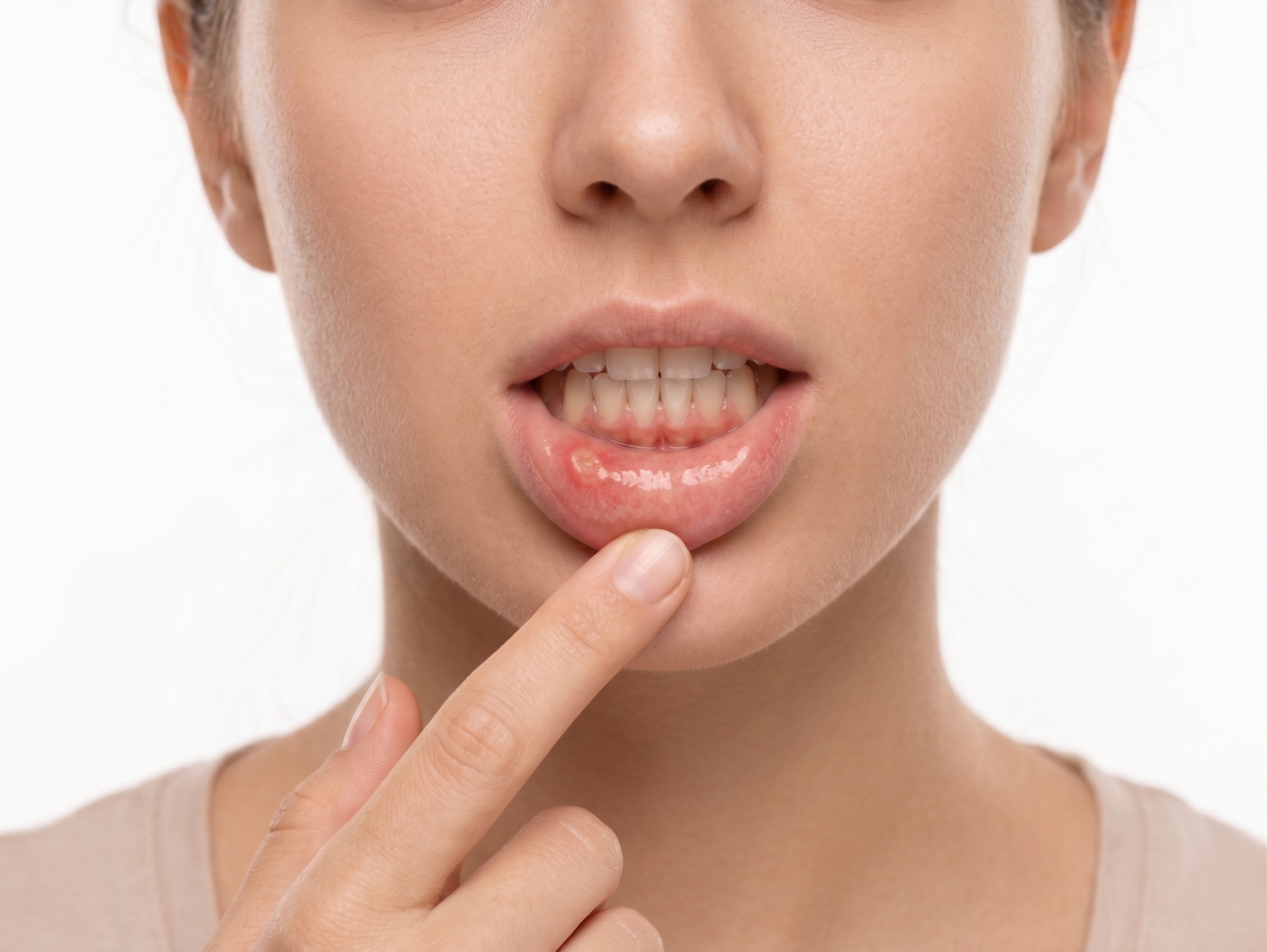
Why do mouth sores appear
Mouth sores — also known as canker sores or aphthous ulcers — have a multifactorial origin: in most episodes, several triggers occur simultaneously, which explains why they can appear during periods of stress even when nothing has changed in the person’s diet.
Nutritional deficiencies are the most frequent cause and the most easily corrected. A deficit of vitamin B12, folic acid, iron and zinc is consistently associated with recurrent aphthous ulcers. In people following vegetarian or vegan diets without adequate supplementation, B12 deficiency is a particularly common trigger for repeated episodes.
Hormonal changes explain why mouth sores are significantly more frequent in women: they appear more often during certain phases of the menstrual cycle, during pregnancy and in the perimenopause. If you experience sores during pregnancy, visit our guide on oral health during pregnancy and breastfeeding.
Emotional stress acts as a trigger through neuroendocrine mechanisms that reduce the local immune response of the oral mucosa. Microtrauma — accidentally biting the cheek, friction from a sharp filling edge or metal brackets — produces isolated sores at the exact point of injury.
A frequently overlooked cause is sensitivity to sodium lauryl sulphate, the foaming agent found in most conventional toothpastes. In susceptible individuals, this compound directly irritates the mucosa and encourages sore formation. Switching to a sodium lauryl sulphate-free toothpaste can noticeably reduce the frequency of episodes.
In a minority of cases, mouth sores are the oral manifestation of systemic diseases — Crohn’s disease, coeliac disease, lupus erythematosus or Behçet’s disease — situations where the pattern of lesions is more extensive, more frequent and refractory to standard treatment. These cases require evaluation by a specialist in oral diseases.
How to cure mouth sores: treatments step by step
Treatment of mouth sores has two distinct objectives: relieving pain during the episode and, when sores are recurrent, addressing the predisposing factor to reduce how often they return. Most minor aphthous ulcers heal on their own within a week, but the following steps accelerate healing and reduce pain significantly.
Home remedies for mouth sores
Saltwater rinses are the first resource available in any home: dissolving half a teaspoon of salt in a glass of warm water and rinsing for 30 seconds three or four times a day reduces the bacterial load on the ulcer and promotes tissue healing. A 0.9% saline solution is particularly well tolerated and can be applied as often as needed without risk of additional irritation.
Diluted hydrogen peroxide — one part hydrogen peroxide to one part water — applied directly to the sore with a cotton swab has a debriding effect that cleans the surface of the ulcer. Contact may produce a brief mild stinging that disappears within seconds.
Pure aloe vera gel applied to the sore after brushing — waiting at least 15 minutes after brushing to avoid diluting it — provides anti-inflammatory, antimicrobial and healing properties that reduce pain and shorten recovery time. It is one of the options with the strongest evidence among natural remedies.
Baking soda dissolved in water (one teaspoon per glass) neutralises the acidic pH around the ulcer and reduces the pain associated with contact from acidic foods. It does not heal the sore, but it improves comfort during the episode.
Pharmaceutical treatments for canker sores
When pain is intense or the sore is large, home remedies are not enough. Topical corticosteroids in gel or rinse form — triamcinolone, betamethasone or clobetasol depending on the severity of the lesion — are the first-line pharmaceutical treatment: they reduce inflammation quickly and shorten the episode duration in a clinically proven way. They require a prescription or dental indication.
Topical anaesthetics — lidocaine or benzocaine gels available from pharmacies — do not heal the ulcer but temporarily block pain, allowing normal eating and speaking for hours. They are particularly useful before meals.
Low-level dental laser is the most effective option for immediate relief: applied directly to the ulcer in clinic, it produces instant local analgesia and accelerates healing without the need for systemic medication. At Asensio Dental Clinic we have therapeutic laser for the treatment of painful or recurrent mouth sores.
Treatment comparison
| Treatment | Main effect | Speed of relief | Prescription needed |
|---|---|---|---|
| Saltwater rinse | Antiseptic, healing | Gradual | No |
| Aloe vera | Anti-inflammatory, healing | Gradual | No |
| Diluted hydrogen peroxide | Debriding | Immediate (cleansing) | No |
| Topical anaesthetic (lidocaine) | Analgesic | Immediate | No |
| Topical corticosteroid | Anti-inflammatory, healing | Fast (24–48h) | Yes |
| Low-level laser | Analgesia + healing | Immediate | Clinic |
Foods that help heal mouth sores
Diet plays a dual role in managing mouth sores: certain nutrients accelerate healing during an episode and reduce the likelihood of new outbreaks when maintained at adequate levels on a regular basis.
The nutrients with the strongest evidence in preventing recurrent sores are vitamin B12 — found in meat, fish, shellfish and dairy products, with supplementation essential for strict vegetarians —, folic acid — abundant in lentils, spinach, broad beans and peas —, iron — in red meat, pulses and nuts — and zinc — in pumpkin seeds, beef and legumes.
Vitamin C — found in citrus fruits, kiwi, peppers and leafy green vegetables — is essential for collagen synthesis and healing of the oral mucosa. A deficit is associated with inflamed gums and slow healing of any oral wound. Smokers have vitamin C requirements up to three times higher than non-smokers.
During the days the sore lasts, it is advisable to avoid very hot or crunchy foods that mechanically traumatise the ulcer, very acidic foods — large amounts of citrus or tomato —, heavily spiced or spicy foods, and anything with a hard texture that may rub directly against the lesion. Alcohol and tobacco irritate the mucosa and significantly delay healing.
Good daily oral hygiene complements diet: keeping the mouth free of debris and bacteria reduces the risk of secondary infection of the ulcer and promotes an oral environment that supports healing.
When to see a dentist for a mouth sore
Most mouth sores do not require a dental visit. However, there are specific situations that justify — and require — specialist evaluation. Knowing these criteria is essential to avoid confusing a benign sore with a lesion that needs differential diagnosis.
The 14-day rule is the most important: an ulcer that has not healed in two weeks is not a simple aphthous sore. It may be a potentially malignant lesion requiring urgent biopsy. This criterion applies regardless of the size, pain level or appearance of the ulcer.
Other criteria for consultation include high frequency — more than three episodes per year —, size greater than one centimetre in diameter, the presence of multiple simultaneous lesions, occurrence accompanied by fever or lymphadenopathy, and any painless ulcer with irregular or hardened edges in a person with oncological risk factors — smoking, high alcohol consumption or HPV infection.
The differential diagnosis between a benign aphthous ulcer and a potentially malignant lesion can only be made by a specialist in oral medicine through direct examination. When in doubt, always seek advice.
Frequently asked questions about how to cure mouth sores
How long does a mouth sore take to heal?
A minor aphthous ulcer heals spontaneously within 7 to 14 days without leaving a scar. Major sores — larger than one centimetre — may last between 2 and 6 weeks. If the ulcer has not healed within 14 days, a specialist evaluation is necessary to rule out other causes.
What is the best way to cure a mouth sore quickly?
Low-level laser applied in clinic is the method with the fastest relief: it produces immediate analgesia and accelerates healing in a single session. At home, the combination of saltwater rinses and aloe vera gel is the protocol with the best available evidence. Topical corticosteroids are the most effective pharmaceutical option for reducing the duration of the episode.
Are mouth sores contagious?
No. Aphthous ulcers are not contagious because they are not infectious in origin: they are ulcers of multifactorial cause — immunological, nutritional, hormonal — with no involvement of contagious viruses or bacteria. Unlike cold sores, which are contagious and caused by the herpes simplex virus, mouth sores are not transmitted through direct contact.
Why do I always get mouth sores in the same spot?
Sores tend to reappear at the same points because those areas have greater susceptibility due to anatomical reasons — increased friction with the teeth, thinner mucosa — or repeated microtrauma. If they consistently appear in the same location, it is worth checking whether a local factor — a sharp filling edge, bracket friction, tooth malposition — is triggering them.
Does stress cause mouth sores?
Yes. Emotional stress is one of the most well-documented triggers of recurrent aphthous ulcers. It acts through neuroendocrine mechanisms that reduce the local immune response of the oral mucosa, leaving it more vulnerable. It does not directly cause the sore, but it lowers the threshold of occurrence in predisposed individuals.
When can a mouth sore be dangerous?
An oral ulcer is potentially dangerous when it does not heal in 14 days, when it is painless — malignant lesions frequently do not hurt —, when it grows progressively, when it has irregular or hardened edges, or when it appears in a person with oral cancer risk factors. In any of these situations, specialist consultation is urgent.